

Festival Tarp Guide UK 2026: How a £20 Tarp Transforms Your Campsite
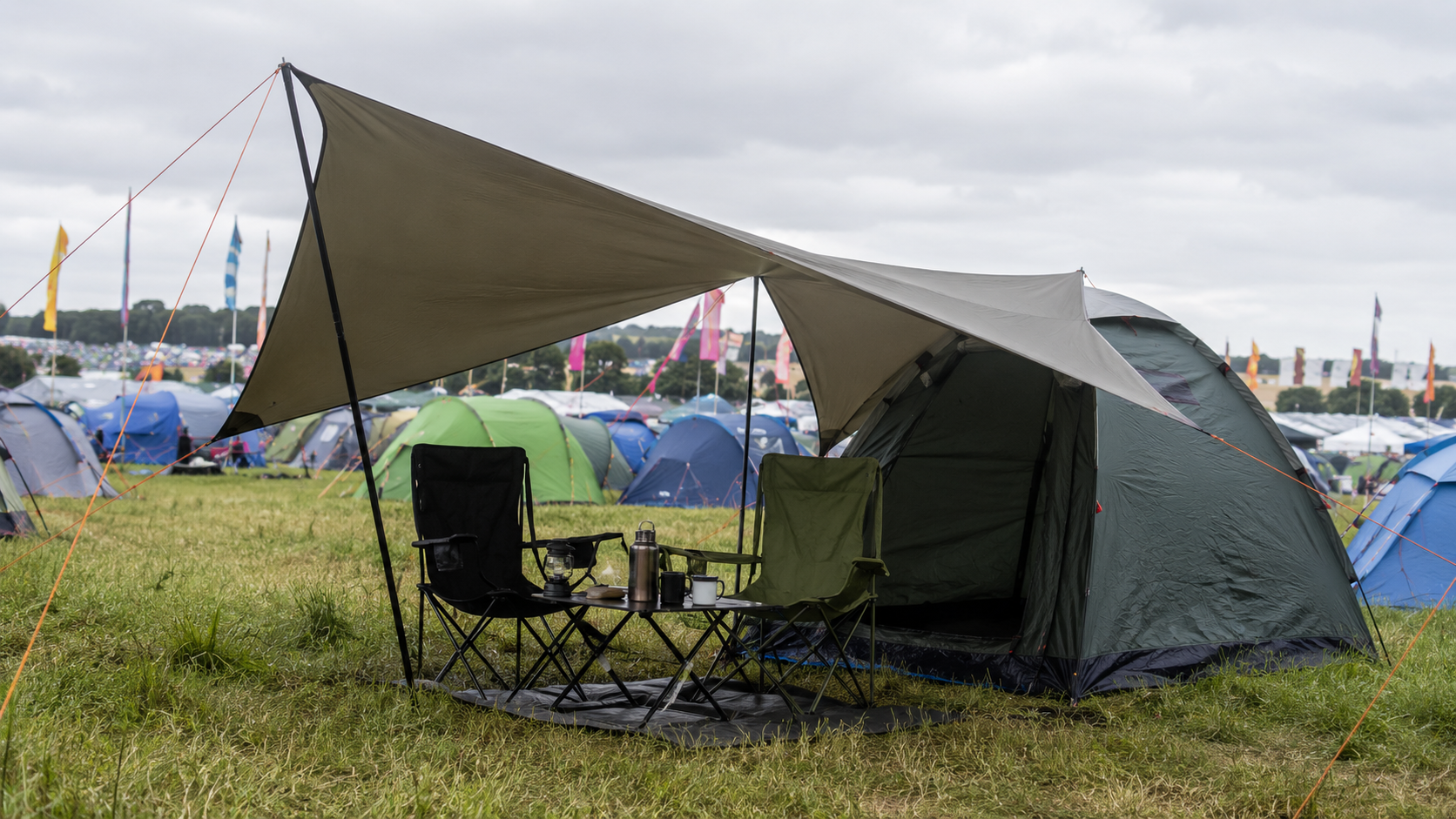
A tarp is the single highest-impact £20 you can spend on a UK festival — and most people don’t bring one. It creates a covered area outside your tent for cooking, eating, sitting in the rain, drying kit and shading from the sun. A 3x3m tarp packs down to the size of a paperback, weighs under a kilo, and changes the whole feel of your campsite. This is the practical guide to festival tarps in the UK — what size, how to pitch one, what to put under it, and the few mistakes to avoid. Pairs with Festival Camping Tips UK and Festival Camping Hacks UK 2026.
Festival prep, sorted. The free printable Festival Survival Guide PDF — your full pre-festival checklist.
Quick answer: do I need a tarp at a UK festival?
Yes — for any camping festival, a 3x3m tarp transforms your setup. Cost: £15–£40 for a basic one, £40–£80 for serious quality. Pitch as a porch over your tent door for rain shelter, or freestanding between trees / poles for a covered campsite social area. Use it for: rain shelter outside the tent, sun shade in heatwaves, cooking under shelter, drying wet kit, additional sleeping area for late-arriving friends. Brands worth looking at: DD Hammocks, Vango, Snugpak, Highlander, Alpkit. Forget proprietary ‘festival-branded’ tarps — basic outdoor brands are better value.
Why a Tarp Beats a Gazebo at UK Festivals
People sometimes consider a pop-up gazebo instead. The reasons tarps win:
- Most UK festivals ban gazebos in standard camping fields. Glastonbury, Reading, Leeds, Download all restrict them. Tarps are universally allowed.
- Tarps weigh 600g–1.5kg. Pop-up gazebos weigh 5–15kg.
- Tarps pack down small. Fit in a rucksack. Gazebos need a separate carry bag and won’t fit on a coach.
- Tarps can be pitched many ways. Gazebos are one shape. Wind kills gazebos by Day 2.
- Tarps cost £15–£40. Pop-up gazebos cost £40–£200.
What Size Tarp for a UK Festival?
| Tarp size | What it shelters | Best for | Price range |
|---|---|---|---|
| 2 x 2m | 1–2 people sat down | Solo or couples, small footprint | £10–£20 |
| 3 x 3m | 3–4 people sat or 2 sleeping | Most festivalgoers, sweet spot | £20–£40 |
| 3.5 x 3.5m / 4 x 4m | 5–8 people group hangout | Group of friends sharing setup | £35–£70 |
| DD 3×3 SuperLight | 3–4 people, ultralight | Coach travellers, weight-conscious | £30–£50 |
How to Pitch a Festival Tarp
There are dozens of tarp pitch methods. Three cover 95% of festival use cases:
1. Lean-to (over your tent door)
The simplest setup. Two corners of the tarp tied to your tent’s apex or to two poles in front of the tent door, two corners pegged at ground level out front. Creates a porch. Keeps rain off the tent door, gives you a dry boot-changing area, and a covered place to sit. Ideal for solo and couples camping.
2. A-frame (between two poles)
Two trekking poles or tarp poles support a ridge line at the centre of the tarp. The four corners peg out at angles. Creates a freestanding shelter — works in any field, not just near trees. Best for groups of 3–6.
3. Plough point (one pole, three corners pegged)
One pole at the front-centre lifts one corner up; the other three corners peg out at angles. Creates an asymmetric shelter that’s easy to pitch one-handed. Useful when wind is consistent from one direction.
💡 Tarp pitching essentials
Whatever the configuration, three things make a tarp pitch reliable: 1) tight ridge line (slack tarp = water pooling = collapse), 2) angled sides (water needs to run off, not pool), 3) wind-aware orientation (closed end into wind, open end downwind). Practice your pitch in the garden once before the festival.
What You Need Beyond the Tarp
A tarp on its own isn’t a campsite shelter. You also need:
- Paracord or guylines. ~5–10m of 4mm paracord (550) — strong enough, light enough.
- Tarp poles or trekking poles. 2x aluminium tarp poles (£10–£20) or your existing trekking poles.
- Tent pegs. The pegs your tent came with often aren’t enough; bring 6–8 spare aluminium pegs.
- A small rubber mallet. A 200g mallet drives pegs into hard ground without damage.
- Carabiners. 3–4 small carabiners for hanging lights, towels, kit from the tarp ridge.
Festival Tarp Setups That Work
Solo / couple: porch lean-to
Your tent door + a lean-to tarp. Costs ~£25 (tarp + paracord + 2 spare pegs). Adds 2-3 sq metres of dry, covered space outside the tent. Means you can boot-change without crouching inside the tent, cook under the porch in light rain, and store wet kit outside without it getting wetter.
Group of 4: A-frame social space
A 4x4m tarp in A-frame configuration creates a 12 sq metre covered hangout. Tents pitched around the perimeter, the tarp in the middle. Costs ~£55 (tarp + 2 poles + paracord + pegs). Transforms the group experience — somewhere to sit, eat, drink and shelter that’s not someone’s tent.
Group of 6+: connected tarps + tents
Two tarps pitched in series — one over the cooking/social area, another between tents as a connecting porch. Costs ~£100 across the group. Often becomes the village hub for surrounding tents to come and hang out at.
Tarp Materials and Construction
| Material | Pros | Cons | Price |
|---|---|---|---|
| Polyester (PU coated) | Cheap, durable, waterproof | Heavier, stiffer | £15–£30 |
| Ripstop nylon | Light, packable, durable | Mid-priced | £25–£50 |
| Silnylon | Ultra-light, packable | Less durable, expensive | £40–£80 |
| DCF (Dyneema) | Lightest, strongest | £100+, fragile to abrasion | £100–£250 |
For a UK festival, polyester or ripstop nylon is the sensible spend. DCF is overkill unless you’re also using it for ultralight backpacking. Forget proprietary ‘festival tarps’ — basic outdoor brands like DD Hammocks, Vango, Highlander and Snugpak are better quality at lower prices.
Tarp Mistakes That Wreck Your Weekend
- Pitching too tight. No flex = wind tears the tarp. Tarps need 5-10% slack at the corners.
- Pitching too loose. Saggy tarp = water pools = sudden water dump on whatever’s underneath. Tighten it up.
- No ridge angle. Flat tarps shed water poorly. Always pitch with at least 15° angle on each side.
- Cheap PVC. The £8 tarp from a discount store leaks within a season. Spend £20+.
- Using tent pegs from your tent. Most tent peg sets only cover the tent. Bring extras.
- Not adjusting for wind. Wind picks up from a different direction overnight. Pegs come out. Re-pitch in the morning.
- Forgetting paracord. A tarp without cord is a square of fabric. Cord is mandatory.
While you’re sorting kit, grab the free Festival Survival Guide PDF for the full camping checklist.
UK Festival Tarp Pitch Etiquette
Some campsite social rules around tarps:
- Don’t peg into a neighbour’s pitch. Tarp guylines go on your side of the line.
- Tie up loose lines at night. Trip hazards in the dark are bad campsite citizenship.
- Don’t pitch a tarp over someone else’s tent without asking. Sounds obvious. Worth saying.
- Take it down on Sunday. A standing tarp on Monday morning is festival litter.
Frequently Asked Questions
Are tarps allowed at UK festivals?
Yes — tarps are universally allowed at UK camping festivals as long as they’re pitched within your own pitch area and don’t infringe on neighbours’ space. Pop-up gazebos are typically banned at major festivals; tarps are not.
How much does a decent festival tarp cost?
£20–£40 for a quality 3x3m tarp from outdoor brands like DD Hammocks, Vango, Highlander or Snugpak. £15–£20 for entry-level options that work for a single weekend. Avoid sub-£10 ‘PVC’ tarps — the seams fail.
What size tarp do I need for 4 people?
A 3x3m tarp shelters 3–4 people sat on chairs. A 3.5×3.5m or 4x4m gives genuine group space. For 4 people sharing a covered social area, 3.5×3.5m is the sweet spot.
Can I pitch a tarp without trees?
Yes. Most tarps can be pitched freestanding using two trekking poles or dedicated tarp poles. The A-frame configuration is freestanding and works in any field. Trees are a bonus, not a requirement.
Will my tarp survive a UK festival in heavy rain?
A properly-pitched 3x3m tarp from DD Hammocks, Vango or similar will handle UK festival rain with no issue. The key is pitch tension and angle — water needs to run off, not pool. Sudden very heavy rain can briefly overwhelm a tarp; angles solve this.
Can I attach a tarp to my tent?
Yes — most modern festival tents have attachment points (loops, eyelets, gear hooks) that can be tied into. Some tents have a porch-extension feature. Don’t tie cords to the tent fabric directly — use the rated attachment points.
Do I need a special pole, or can I use a stick?
A trekking pole or dedicated tarp pole is more reliable than an improvised stick — sticks split, lean and don’t have a flat tip. £10–£15 for a basic aluminium tarp pole is worth it.
Should I bring my own paracord or use the cords supplied?
Most tarps come with thin guylines that work but aren’t generous. Adding a 5–10m length of 4mm paracord covers all the rigging options and lasts years. Buy one decent length once.
Can I sleep under a tarp instead of a tent?
Yes — tarp camping (called ‘tarping’ or ‘fly camping’) is popular among lightweight backpackers. For UK festivals it’s not recommended without insect netting, since UK summer evenings have midges and mosquitoes. Better as a porch over your tent.
How do I dry my tarp after a wet festival?
Pitch it indoors or in a garden after returning home. Wipe down with a damp cloth, let air-dry both sides. Storing a tarp wet leads to mildew that damages the waterproofing. 24 hours of indoor drying is enough.
Related Reading
- Festival Camping Tips UK
- Festival Camping Hacks UK 2026
- Best Festival Tents UK
- What to Do If It Rains at a Festival UK
- Festival Camping with a Group UK
Tarp is one element of campsite setup. The full system sits in the UK Festival Survival Guide.
Disclosure: This post contains affiliate links. If you buy through them, I may earn a commission at no extra cost to you. I only recommend gear and brands I’d actually use at a UK festival.
Discover more from The Mosh Manual
Subscribe to get the latest posts sent to your email.