
Festival Mosh Pit Survival UK 2026: How to Survive (or Avoid) the Pit
UK festival mosh pits are a defining experience for rock, metal, punk and hardcore fans — and a genuinely scary one for the uninitiated. Done right, mosh pits are exhilarating, communal, and surprisingly safe. Done wrong, they cause injuries, lost belongings, and ruin your weekend. There are rules. There are unwritten codes. There are positions in the pit that are safe and positions that aren’t. And there are specific moves that protect you — and your fellow moshers — across a 90-minute set. This is the practical guide to UK festival mosh pits — what to wear, how to position, the universal rules, and how to avoid pits if you don’t want one. Pairs with Best Stage Position at a Festival UK and Festival First Aid Kit UK.
Festival prep, sorted. The free printable Festival Survival Guide PDF — your full pre-festival checklist.
Quick answer: how do I survive a UK festival mosh pit?
The universal rule: if someone falls, pick them up immediately. Everyone in the pit, every time. What to wear: closed-toe shoes (no flip-flops), no loose jewellery, no glasses without straps, no items in back pockets. Where to position: 5-10 rows behind the pit centre for the energy without being centre. What to bring: bumbag at the front, nothing in back pockets, water bottle, earplugs. What NOT to do: push your way to the front during the set, intentionally hurt people, stay in the pit if you’re scared. Exits: sideways, not backwards. The crowd shifts; ride it sideways and walk out.
The Universal Mosh Pit Rules
Some unwritten codes that experienced moshers follow:
- If someone falls, you pick them up. Universal across all pit types. The fastest way to be ejected from the crowd is to walk past someone on the ground.
- No fighting. Pits are intense, not aggressive. Anyone clearly hitting people on purpose gets ejected by the crowd itself.
- Respect personal space outside the pit edge. The ‘wall’ is the edge; people there are watching, not participating.
- Help people exit if they want out. If someone looks scared or hurt, help them get to the edge.
- Water hand-outs. Pass water bottles forward when offered; help dehydrated people.
- Watch out for kids and smaller people. Younger and shorter folks in pits get knocked down more easily.
- Don’t crowd-surf during slow songs. Disrupts the vibe; not the appropriate moment.
- Crowd-surfers go feet-first. Head-first crowd-surfing is dangerous.
- If the band tells you to back up, back up. Usually a safety call.
Mosh Pit Types
Standard mosh pit
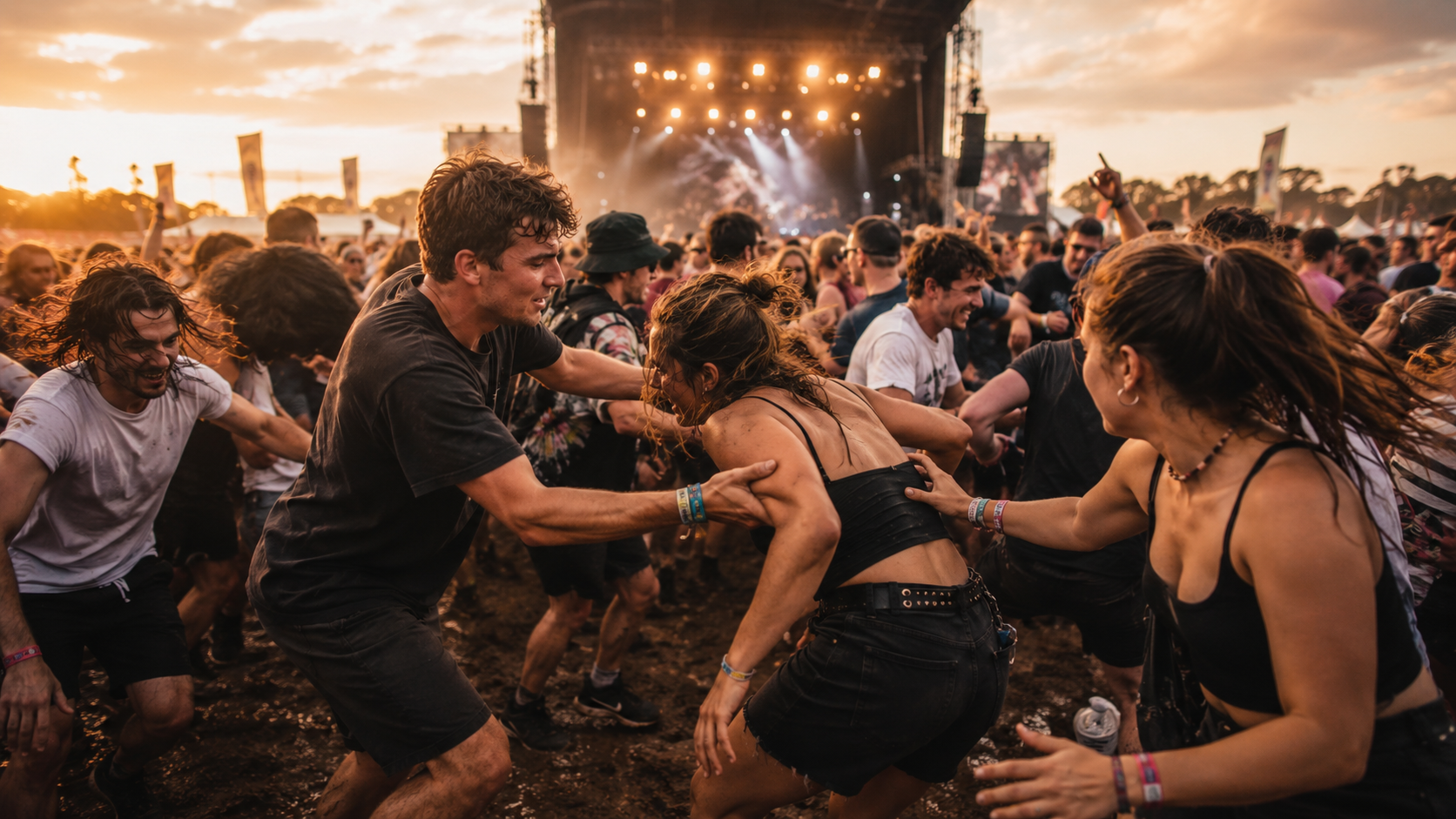
Crowd opens up; people run/push around the inside of the circle. Centre is the most chaotic. Lasts the duration of a song or sometimes an entire set.
Wall of death
Pit splits in half; two sides run at each other on the band’s signal. Maximum impact moment. Common at metal festivals like Download. Tip: brace yourself, keep arms slightly out for protection, don’t stand exactly on the centre line.
Circle pit
Crowd runs around in a circle (clockwise or anticlockwise). More fluid than a standard pit; people get caught in the running flow. Tip: join the flow; don’t try to stand still in the middle of it.
Crowd surfing
Person is lifted overhead and passed forward to security at the front rail. Common during high-energy moments. Tip: if you’re lifted, stay rigid (easier to pass); cross arms across chest; keep feet pointed forward.
Push pit
Heavy crowd pressure pushing forward. Not a traditional ‘mosh’ but feels like one. Common at non-rock genres when the band emerges.
⚠️ When pits become dangerous
Most pits are safe; some get out of control. Signals: the crowd is moving as a single mass (crushing risk), people falling and not being picked up, someone shouting clearly ‘I can’t breathe’, security pushing in to extract. If any of these happen, work your way out sideways immediately. Don’t wait for the situation to improve. A few injured pit-goers ruin a festival every year — don’t be one.
What to Wear for the Pit
Pit-appropriate clothing:
- Closed-toe shoes. Trainers, walking boots. Flip-flops or open sandals = broken toes.
- Long-sleeved top (optional but useful). Reduces skin scrape.
- Tight or no jewellery. Necklaces and bracelets get caught and torn.
- No glasses without straps. Bring a glasses strap (£5-£10) or contacts for the pit.
- Hair tied back. Hair-pulling injuries are real.
- Nothing in back pockets. Phones and wallets get crushed/lost.
- Bumbag at the front, not the back. See bumbag guide.
- Earplugs in. Loop or Mack’s; sustained exposure is genuinely damaging.
For the specific bag question, see the Bumbag vs Crossbody UK Festivals guide. For glasses straps, check sport glasses straps (£5-£12).
What to Avoid Bringing
- Open drinks. They spill. Sealed bottle or wait.
- Phone in hand. Lost or damaged.
- Camera around neck. Strangled or smashed.
- Loose jewellery, dangly earrings. Caught on others.
- Expensive sunglasses without strap. Lost.
- Anything in shopping bag form. Bags get caught and torn.
- Backpack worn on back. Pushes people behind; awkward in the pit. If wearing one, swing it round to the front.
Pit Positioning Strategy
Centre of the pit
Maximum chaos. Most physical experience. Most fun for dedicated moshers; most overwhelming for first-timers.
Edge of the pit
You’re moshing but at the boundary. Easier to step out if needed. Recommended for first-timers wanting the experience without full immersion.
Wall of the pit
The ‘pit wall’ is the row of people standing around the circle. You’re not actively moshing but you’re protecting moshers from being pushed into the wider crowd. Good position for groups where one wants to mosh and another wants to watch.
5-10 rows behind the pit
You feel the energy without being in it. Crowd-surfers come over you. Some pushing forward. Excellent first-mosh-pit-adjacent position.
Far behind the pit
Pit-watching from a safe distance. Most casual rock fans choose this.
Exiting a Pit Mid-Song
If you need to get out — pit got too rough, you’re injured, claustrophobic — the method:
- Don’t fight backwards through the crowd. Crowds push forward; you’ll fight the entire mass.
- Move sideways, not backwards. Towards the edges of the crowd, not the back.
- Tap on shoulders and say ‘sorry, going out’. Most people will let you through.
- If you’re seriously hurt, signal security. Look at the rail; staff watch for raised arms and distress signs. They’ll extract you.
- Don’t wait for a song to end. Pits don’t pause between songs.
- Walk decisively. Hesitation slows everyone down.
If Someone Falls
- Stop moving in their direction. Most pit-related crush injuries happen when people keep pushing.
- Shout ‘someone down!’ to alert nearby moshers.
- Help them up immediately. Lift from the armpits if possible.
- If they look hurt, signal security.
- If they can’t get up, protect them. Stand over them, arms out, until they can stand or be extracted.
Pit-Friendly Festivals in the UK
| Festival | Pit culture | Notes |
|---|---|---|
| Download | Heavy. Wall of death, circle pits, crowd surfing | The UK’s premier pit festival |
| Reading / Leeds | Heavy at rock stages; lighter at pop | Diverse pit experience depending on stage |
| Slam Dunk | Punk/hardcore pits | Smaller crowds; more intense pits |
| Bloodstock | Metal-specific; pits at every stage | Heaviest pit culture at any UK festival |
| 2000 Trees | Punk/alternative | Friendly, smaller pits |
| Glastonbury | Variable; pit at Other Stage rock acts, none at Pyramid headliners | Rare main-pit experience |
| Boomtown | Mostly dance/electronic; pits at metal stages only | Pit culture depends entirely on the stage |
| Latitude / Green Man | Minimal pit culture | Generally calmer crowds |
While you’re sorting kit, grab the free Festival Survival Guide PDF for the full prep list.
Avoiding Pits Entirely
If you’re not into pits, the positioning to avoid them:
- Sides of the crowd. Pits rarely form on the sides; centre-front is where they happen.
- Back of crowd. Pits don’t reach back of crowd.
- Pit-free festivals. Latitude, Green Man, Camp Bestival, End of the Road — minimal pit culture.
- Genre choice. Pop, indie pop, folk, jazz, electronic — pit-free zones.
- Sound desk position. Almost always pit-free; the technical crowd doesn’t mosh.
Post-Pit Care
After a heavy pit:
- Water and electrolytes immediately. You’ve lost significant fluid.
- Check for injuries. Bruises develop later; ankles and shoulders most common.
- Stretch. Festival pit + festival walking + festival sleep = stiffness.
- Magnesium in the evening. Muscle recovery support.
- Hot meal. Calories and protein for recovery.
- If feeling dizzy or unwell, go to medical. Heat exhaustion or genuine injury can hide under ‘I’m just tired’.
Frequently Asked Questions
Are festival mosh pits dangerous?
Generally safe but with risks. The biggest risks: heat exhaustion, lost belongings, twisted ankles, occasional bruising. Serious injuries are rare with crowd cooperation (picking up fallen people, helping injured exit). UK festival security is strong; rail-extraction for distressed pit-goers is routine.
What’s the most important mosh pit rule?
If someone falls, you pick them up. Universal across rock, metal, punk and hardcore. The pit functions because of crowd cooperation — anyone who walks past a fallen person without helping gets ejected by the crowd itself.
What should I wear in a mosh pit?
Closed-toe shoes (trainers or walking boots), no flip-flops, no loose jewellery, no glasses without straps, hair tied back, nothing in back pockets, bumbag at front not back. Comfortable clothes — moshing is sweaty and physical.
Can I mosh in glasses?
Yes, with a strap. Sport glasses straps (£5-£12) keep glasses on during pit movement. Contacts are better if you have them. Don’t mosh in glasses without securing them — they will come off and likely be broken.
How do I get out of a mosh pit if it gets too rough?
Move sideways towards the edges, not backwards through the crowd. Tap shoulders and say ‘going out’. Most pit-goers will let you through. If seriously hurt, signal to security at the rail by raising both arms — they’re trained to extract distressed pit-goers.
Should I crowd surf?
Optional. If you do: stay rigid (easier to be passed forward), cross arms across chest, keep feet pointed forward. Don’t crowd-surf during slow songs (disrupts the vibe). Head-first surfing is dangerous; feet-first is safer.
Can I bring a backpack into a mosh pit?
Possible but not recommended. If you must, swing it round to the front rather than wearing on back — back-worn bags push people behind you. A bumbag worn at the front is better. Some festivals have free bag drop near the mainstage; use it for the headliner pit.
Are there mosh pits at Glastonbury?
Occasionally at the Other Stage for rock acts, rarely at the Pyramid Stage headliners. Glastonbury crowds are generally more relaxed than dedicated rock festivals. For genuine pit culture, Download or Reading is better.
What’s a wall of death?
Pit splits in half on the band’s signal; two sides run at each other when the song hits a specific moment (usually a heavy breakdown). Maximum impact moment. Brace yourself, keep arms slightly out, don’t stand exactly on the centre line where collisions are hardest.
Are mosh pits suitable for women?
Yes — many women are dedicated pit-goers. Some pit cultures are more or less welcoming; metal/hardcore tends to be more inclusive than older rock cultures. The main concerns (the same for all genders): wear pit-appropriate clothes, position thoughtfully, accept the universal rules. Many UK festivals have ‘safer space’ initiatives that have improved gender dynamics in pits significantly.
Related Reading
- Best Stage Position at a Festival UK
- Festival First Aid Kit UK
- Bumbag vs Crossbody UK Festivals
- Best Earplugs for Concerts and Festivals UK
- Download Festival 2026 Guide
Mosh pits are one piece of the festival experience. Full system in the UK Festival Survival Guide.
Disclosure: This post contains affiliate links. If you buy through them, I may earn a commission at no extra cost to you. I only recommend gear and brands I would actually use at a UK festival.
Discover more from The Mosh Manual
Subscribe to get the latest posts sent to your email.