
Best Dry Bags for UK Festivals 2026: Sizes, Sealing Methods and What to Put in Them
Dry bags are the silent heroes of UK festival kit. Phones, sleeping bags, fresh socks, electronics, ID and cash all stay dry regardless of what the British weather throws at you. They cost £8–£40, weigh almost nothing, and the difference between a wet weekend with dry kit and a wet weekend with wet kit is the difference between a memorable festival and a miserable one. This is the practical guide to dry bags for UK festivals — what sizes you actually need, the sealing methods that work, and the kit you should always have in one. Pairs with What to Do If It Rains at a Festival UK and Ultimate Festival Packing List UK.
Festival packing, sorted. The free printable Festival Survival Guide PDF — your full pre-festival checklist.
Quick answer: which dry bags do I need for a UK festival?
Most people need 3 dry bags: a 20–30L for sleeping bag and clothes (the big one), a 5–10L for electronics and valuables (the everyday one), and a 1–3L for phone and wallet (the day bag insert). Roll-top sealing is the standard — it’s reliable, repairable and fits any size. Zip-seal dry bags exist but fail more often. Don’t bother with PVC ultra-cheap bags — the seams fail by Day 2. Brands like Sea to Summit, Osprey, Karrimor and Vango all make reliable festival-spec dry bags at £15–£35.
Why Dry Bags Matter More Than People Think
UK festival weather is unpredictable. Even forecast-sunny weekends can deliver a 30-minute downpour at midnight as you’re walking back to the tent. Tents leak when pitched poorly. Rucksacks aren’t waterproof — they’re water-resistant at best. The single most common Day 2 disaster at a UK festival is a soaked sleeping bag, a dead phone, or a wet change of clothes. All three are prevented by dry bags. Cost-of-failure context:
- Soaked sleeping bag: a wet down or synthetic bag won’t dry overnight in a tent. You’re sleeping in a damp bag for the rest of the festival.
- Wet phone: the festival is your camera, your map, your tickets and your communication. A dead phone is genuine functional failure.
- Wet socks and underwear: chafing, blisters and trench foot are real on a 4-day festival. Dry socks every morning is non-negotiable.
- Soaked food: bread goes mouldy by Day 2 if it gets wet. Powdered milk, cereal, sugar — all destroyed.
Dry Bag Sizes: What You Actually Need
| Size | What it holds | Where it lives | Priority |
|---|---|---|---|
| 1–3L | Phone, wallet, keys, ID | Inside your day bag | Essential |
| 5–10L | Spare clothes, electronics, power bank, camera | Inside your day bag or rucksack | Essential |
| 20–30L | Sleeping bag, clothes, towel | Inside your main rucksack | Essential |
| 35–60L | Whole rucksack contents (pack-liner) | Lining your rucksack | Optional but excellent |
| Compression dry bag | Sleeping bag specifically | Top of rucksack | Useful for small tents |
Sealing Methods: Roll-Top vs Zip
Roll-top dry bags (recommended)
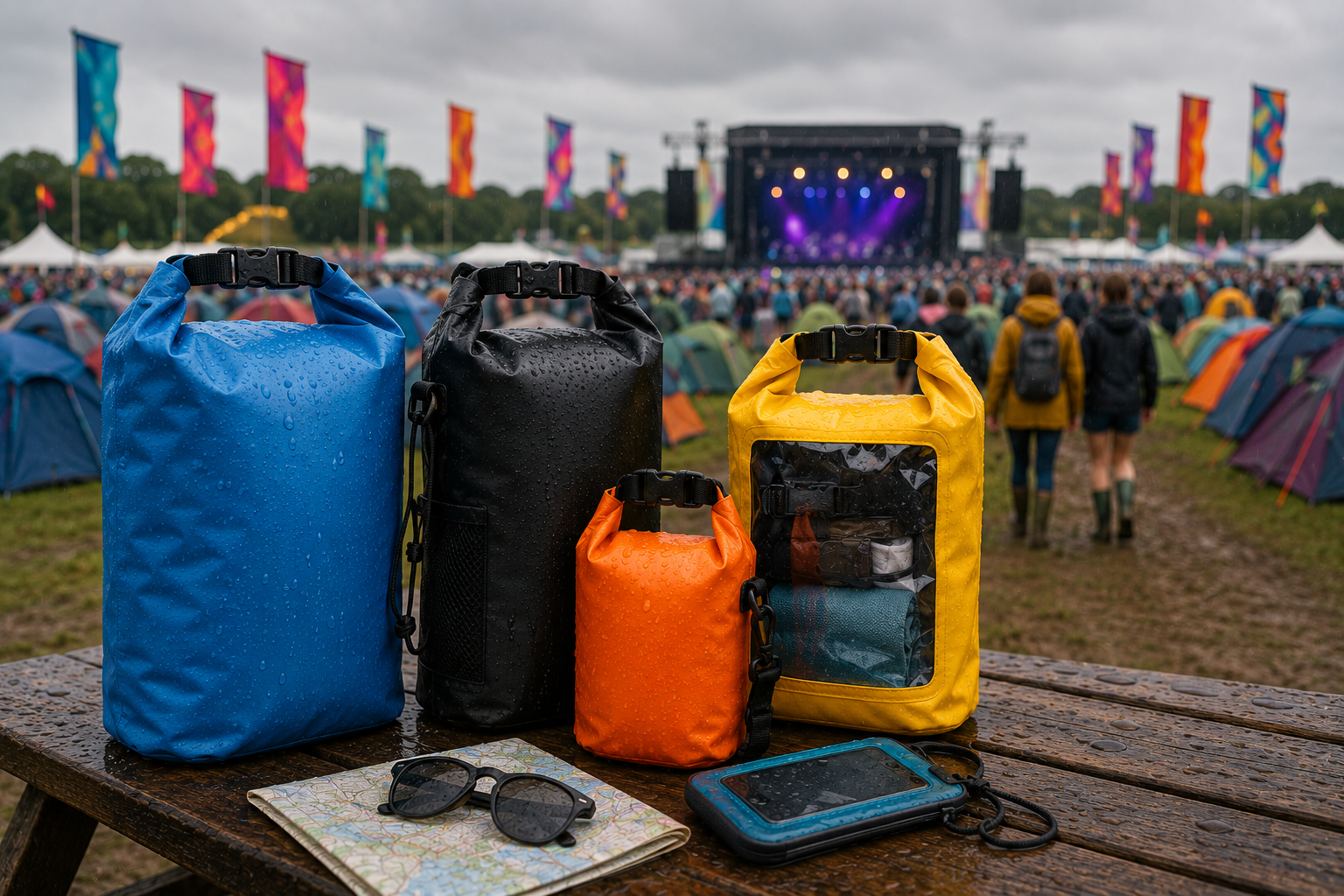
The classic dry bag design. The opening rolls down 3-4 times, then clips together. Provides reliable waterproofing for everything except submersion in deep water (and even then, brief submersion is usually fine). The advantages:
- Reliable — the seal works regardless of what’s inside
- Compresses your kit — the more you roll, the more air you squeeze out
- Repairable — a punctured roll-top can be patched with seam sealant
- Universal sizes — you can stuff one inside another for layered protection
Examples worth looking at: Sea to Summit Lightweight, Karrimor roll-top, Osprey Ultralight.
Zip-seal dry bags
Use a waterproof zipper rather than rolling. Quicker access, no rolling required. The trade-offs:
- Zip teeth wear out — most fail within 2–3 seasons of regular use
- Single point of failure — if the zip breaks, the whole bag is compromised
- More expensive than roll-tops
- Less compressible — you can’t squeeze out air the way you can with rolling
For a festival-specific scenario, roll-top wins. Zip-seals make more sense for kayakers and watersports. Examples: Zip-seal dry bags.
Compression dry sacks
A compression sack with built-in waterproofing — combines two functions. Ideal for sleeping bags. Squeezes a 3-season sleeping bag down to about 60% of its uncompressed size. Compression dry sacks are typically £20–£30.
💡 Dry bag fail-safe: layer them
The real-world strategy: a dry bag inside a dry bag. Phone in a 1L dry bag, that goes in a 5L with electronics, that goes in a 30L with clothes. Even if one fails (puncture, bad seal, dropped in a puddle), the inner one is still dry. Costs £25–£40 total for the full setup; saves a weekend if anything fails.
What to Put in Each Dry Bag
The 1–3L pocket dry bag
- Phone in a clear-window dry bag (so you can use it without removing)
- Wallet, ID, ticket backup
- Keys
- A few zip-lock bags for individual receipts/cash
The 5–10L day-pack dry bag
- Power bank and charging cables
- Camera, head torch, batteries
- Spare socks (always)
- Lightweight rain jacket folded down
- First aid essentials: blister plasters, painkillers, sun cream
- Cash in a separate small dry bag inside
- Snacks for the day in resealable bags
The 20–30L main dry bag
- Sleeping bag (compression-dry-sack version is excellent)
- Clean clothes for each day in separate stuff sacks (or zip-locks)
- Towel
- Spare festival outfit for Day 3 (when everything else is destroyed)
- Backup hoodie / fleece for cold nights
The Pack Liner Approach
Some experienced festivalgoers use a single 60–80L pack-liner dry bag inside their entire rucksack rather than multiple smaller bags. Pros: simpler, cheaper, lighter. Cons: every time you open it, your whole rucksack is exposed to rain. For most UK festivalgoers, the multi-bag approach is more practical because you’re constantly accessing different things. Pack-liner options run £10–£25.
Brand Recommendations and Price Tiers
| Tier | Price range | Brands | When it’s the right choice |
|---|---|---|---|
| Budget | £8–£15 | Karrimor, Mountain Warehouse, Highlander | First festival, occasional use |
| Mid | £15–£25 | Vango, Trespass, Decathlon Forclaz | Regular festivals, multi-day camping |
| Premium | £25–£40 | Sea to Summit, Osprey, Exped | Frequent festivalgoers, multi-year investment |
| Specialist | £40+ | Ortlieb, Aquapac, SealLine | Submersion-grade, watersports crossover |
For most UK festivalgoers, the mid tier hits the sweet spot. Vango dry bag sets (3-pack of mixed sizes for around £25) is a popular starting point. While you’re sorting kit, grab the free Festival Survival Guide PDF for the full pre-festival list.
Dry Bag Mistakes to Avoid
- Skipping the test. Test your dry bags at home before the festival — fill with paper, submerge in the bath. Cheap bags often fail this.
- Overfilling. The roll-top needs at least 3 rolls to seal properly. Stuffing a 20L bag with 25L of kit leaves the seal weak.
- Not rolling tightly. Air inside is fine; air pockets near the seal aren’t. Squeeze air out before rolling.
- Buying see-through PVC bags. The seams are typically welded weakly and fail under pressure. Avoid the £4 specials.
- Forgetting the small one. A 1–3L pocket dry bag for phone and wallet is the most-used bag of the lot. Don’t skip it.
- Not using them at home. If you only deploy dry bags on festival weekends, you don’t catch the leaky one until it matters.
- Storing wet. Dry bags need to dry inside-out at home or they smell. Worth the 20 minutes of post-festival drying.
Beyond Festivals: Other Dry Bag Uses
Festival dry bags pay back well beyond festival weekends. They double as: laundry bags for dirty kit on holidays, waterproof picnic hampers, beach kit organisers, gym bag liners (sweaty kit doesn’t soak the rest), camping food storage (mice can’t smell through sealed dry bags as easily), and emergency household waterproofing. Once you have them, they get used. See Festival Camping Hacks UK 2026 for more multi-purpose kit ideas.
Frequently Asked Questions
Are dry bags actually waterproof in a wet UK festival?
Reliable roll-top dry bags from established brands (Sea to Summit, Osprey, Karrimor, Vango) are waterproof for festival use — heavy rain, splashes, brief immersion. They are not submersion-rated unless specifically labelled (e.g. Aquapac). For a UK festival, IPX5-equivalent waterproofing is more than enough.
How many dry bags do I need for a UK festival?
Three at minimum: a small one (1–3L) for phone and wallet, a medium one (5–10L) for electronics and day-pack contents, and a large one (20–30L) for sleeping bag and clothes. A 60–80L pack-liner is optional but excellent for serious wet-weather festivals.
What’s the difference between a dry bag and a stuff sack?
Stuff sacks are storage and compression bags but not waterproof. Dry bags are sealed against water ingress with a roll-top or zip-seal. Compression dry sacks combine both — compressing kit while keeping it dry. For festivals you want dry bags, not just stuff sacks.
Can I use bin liners instead of dry bags?
As an emergency backup, yes. Bin liners (especially heavy-duty contractor bags) provide reasonable waterproofing for one weekend. The drawbacks: no reusable closure (twist-and-tuck only), tear easily if snagged, and you end up with a bag of rubbish to dispose of. Dry bags are far better for repeat use.
Are clear dry bags worth it?
Clear dry bags are useful for the small (1–3L) bag where you want to use your phone without removing it. For larger bags, opaque or coloured fabric is more durable. Most people want at least one clear bag for phone/map use.
Do dry bags float?
Most roll-top dry bags float when sealed because of the air trapped inside — assuming they’re not overfilled. Useful in flooded festival fields or when crossing wet ground.
How long do dry bags last?
A quality roll-top dry bag (Sea to Summit, Osprey, Karrimor) lasts 5–10 years of regular use. Cheap PVC bags often fail within one festival season. The buckle is usually the first thing to break.
Can I machine-wash a dry bag?
Most dry bags should be hand-washed only — machine washing can damage seam tape and waterproof coatings. Wipe down the inside with a damp cloth, hang inside-out to dry. Mild soap is fine for stubborn dirt.
What’s an IPX rating and does it apply to dry bags?
IPX is the international standard for water resistance, but it’s typically applied to electronics, not dry bags. For dry bags, look for descriptions like ‘roll-top with welded seams’ or ‘submersible to X depth’ — these tell you more than an IPX number.
Should I get a coloured or black dry bag?
High-visibility colours (orange, yellow, blue) help you find a dropped bag in mud or grass. Black dry bags blend into kit and are harder to spot if dropped. For festival use, brighter colours are practical.
Related Reading
- What to Do If It Rains at a Festival UK
- The Ultimate Festival Packing List UK
- Best Festival Rucksacks UK 2026
- Festival Camping Hacks UK 2026
- Best Festival Waterproof Jackets UK
Dry bags are one piece of the kit puzzle. The full system sits in the UK Festival Survival Guide.
Disclosure: This post contains affiliate links. If you buy through them, I may earn a commission at no extra cost to you. I only recommend gear and brands I’d actually use at a UK festival.
Discover more from The Mosh Manual
Subscribe to get the latest posts sent to your email.