

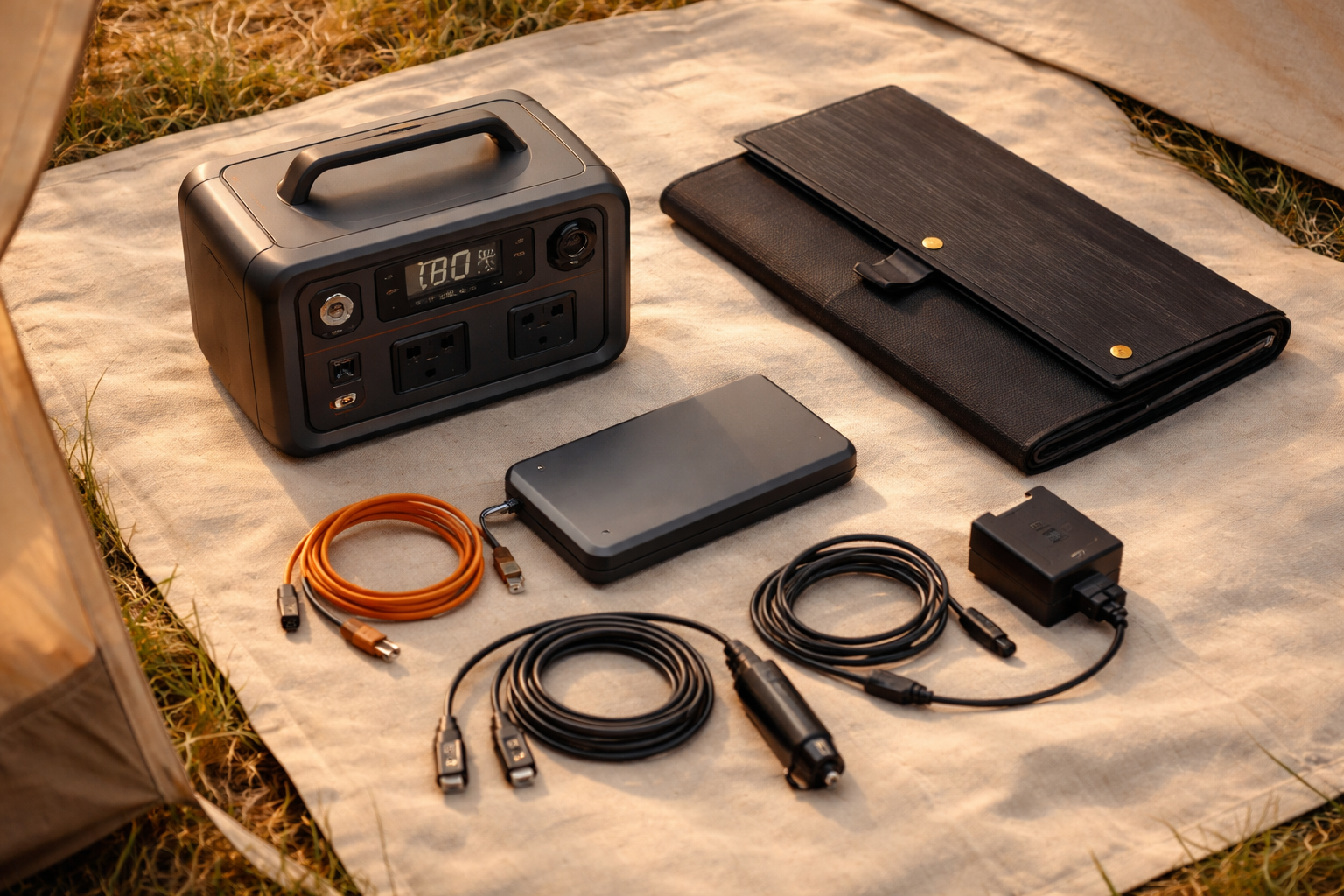
Quick answer: what portable power do I need for camping and off-grid use?
It depends on what you need to run. For charging phones and small devices: a 20,000mAh power bank (Anker 737 or UGREEN Nexode) covers most people for 3–4 days. For running laptops, CPAP machines, or small appliances: a portable power station (EcoFlow RIVER 2 Pro or Jackery Explorer 1000 Plus) is what you need. For truly off-grid or extended trips: a power station paired with a folding solar panel gives you indefinite capacity as long as the sun shines. For home emergency backup: the EcoFlow DELTA 2 Max or Bluetti AC200L covers your essential appliances through a power cut.
Modern outdoor life runs on electricity. Your phone, your GPS, your camera, your CPAP, your camping fridge, your lights — all of it needs power, and the UK grid is not always nearby. Whether you are at a festival field, a wild camping pitch, a van conversion, or planning for a power cut at home, this guide covers every portable power option available to UK buyers right now.
This is not just a list of products. It is a complete education in how portable power works — what the specs mean, how to size your system, how solar panels work in the UK’s unpredictable weather, and which products genuinely deliver versus which ones disappoint in real-world outdoor conditions.
👉 See our dedicated festival power banks guide for festival-specific picks and campsite charging strategy. This guide covers the broader picture — camping, van life, off-grid living, and emergency home power.
Master comparison table
| Product | Category | Capacity | Key output | Best for | Price range | Amazon |
|---|---|---|---|---|---|---|
| Anker 325 PowerCore 20K | Power bank | 20,000mAh / 74Wh | 15W USB-A | Budget phone charging | ~£25–£35 | View |
| Baseus Adaman 20K | Power bank | 20,000mAh / 74Wh | 65W USB-C PD | Budget fast-charge | ~£30–£45 | View |
| Xiaomi PB3 20K | Power bank | 20,000mAh / 74Wh | 50W USB-C PD | Budget reliable | ~£28–£40 | View |
| Anker 737 PowerCore 24K | Power bank | 24,000mAh / 89Wh | 140W USB-C PD | Laptops + phones | ~£70–£90 | View |
| UGREEN Nexode 25K | Power bank | 25,000mAh / 93Wh | 130W USB-C PD | Best mid-range | ~£65–£85 | View |
| Anker Prime 27.6K | Power bank | 27,648mAh / 99Wh | 250W USB-C PD | Premium laptop power | ~£130–£160 | View |
| Anker MagGo 10K | Power bank | 10,000mAh / 37Wh | 15W wireless + 20W USB-C | Wireless everyday carry | ~£45–£60 | View |
| EcoFlow RIVER 2 Pro | Power station | 768Wh | 800W AC (1,600W surge) | Best entry power station | ~£400–£500 | View |
| EcoFlow DELTA 2 | Power station | 1,024Wh | 1,800W AC (2,700W surge) | Best mid-range station | ~£600–£750 | View |
| EcoFlow DELTA 2 Max | Power station | 2,048Wh | 2,400W AC (5,000W surge) | Van life / home backup | ~£1,100–£1,400 | View |
| Jackery Explorer 1000 Plus | Power station | 1,264Wh | 2,000W AC (4,000W surge) | Best Jackery mid-range | ~£700–£900 | View |
| Jackery Explorer 2000 Plus | Power station | 2,042Wh | 3,000W AC (6,000W surge) | Base camp / van life | ~£1,400–£1,800 | View |
| Bluetti EB70S | Power station | 716Wh | 800W AC (1,400W surge) | Best Bluetti entry | ~£380–£480 | View |
| Bluetti AC200L | Power station | 2,048Wh | 2,400W AC (3,500W surge) | Best premium LiFePO4 | ~£1,200–£1,500 | View |
| Anker SOLIX C800 | Power station | 768Wh | 800W AC (1,200W surge) | Best Anker station | ~£450–£550 | View |
| Goal Zero Yeti 1000X | Power station | 983Wh | 1,500W AC (3,000W surge) | Premium modular | ~£900–£1,100 | View |
| Pectron 500W | Power station | 500Wh | 500W AC | Best budget station | ~£180–£250 | View |
| EcoFlow 220W Bifacial Panel | Solar panel | 220W | MPPT compatible | Best portable solar | ~£250–£350 | View |
| Jackery SolarSaga 200W | Solar panel | 200W | MPPT compatible | Best Jackery solar | ~£220–£300 | View |
| Bluetti PV200 | Solar panel | 200W | MPPT compatible | Best Bluetti solar | ~£200–£280 | View |
| BigBlue 28W | Solar panel | 28W | USB-A/C direct | Best portable day hike | ~£40–£60 | View |
| Goal Zero Nomad 100 | Solar panel | 100W | MPPT compatible | Best premium portable | ~£200–£280 | View |
The four categories of portable power explained
Quick answer: what is the difference between a power bank and a portable power station?
A power bank stores energy in the 10,000–30,000mAh range and charges phones and small devices via USB. A portable power station stores far more energy (measured in watt-hours, typically 500Wh–2,000Wh+), has AC mains sockets, and can run laptops, CPAP machines, mini-fridges, and camping appliances. A power bank fits in your pocket. A power station is the size of a small suitcase. Both are useful — they solve different problems.
| Category | Capacity range | What it runs | Weight | Price range | Best for |
|---|---|---|---|---|---|
| Power bank | 10,000–30,000mAh (37–111Wh) | Phones, earbuds, small cameras, tablets | 200g–700g | £20–£160 | Day trips, festivals, travel |
| Portable power station | 200Wh–5,000Wh+ | Laptops, CPAP, fridges, lighting, power tools | 5kg–30kg+ | £150–£3,000+ | Camping, van life, home backup |
| Solar panel | 20W–400W (portable) | Charges power banks and stations | 1kg–8kg | £40–£500 | Extended off-grid, van life |
| Battery backup / UPS | 500Wh–10,000Wh+ | Home appliances, medical equipment, whole-home | 15kg–100kg+ | £500–£10,000+ | Home emergency, off-grid living |
Specs explained — everything you need to understand before buying
mAh vs Wh — which number actually matters
Quick answer: what is the difference between mAh and Wh in power banks?
mAh (milliamp-hours) measures charge at a specific voltage. Wh (watt-hours) measures actual energy. Wh is the honest number — always use it for comparison. A 20,000mAh power bank at 3.7V internal voltage stores 74Wh. But delivered to a 5V USB device, efficiency losses mean you get roughly 60–65Wh of usable energy. The conversion formula: mAh × 3.7 ÷ 1000 = Wh (approximate). Power stations always quote Wh because the math is more straightforward at higher capacities.
| Stated mAh | Approximate Wh | Usable Wh (after losses) | iPhone 15 charges (est.) | Samsung S24 charges (est.) |
|---|---|---|---|---|
| 10,000mAh | ~37Wh | ~30Wh | ~2.5 charges | ~2 charges |
| 20,000mAh | ~74Wh | ~60Wh | ~5 charges | ~4 charges |
| 25,000mAh | ~93Wh | ~75Wh | ~6 charges | ~5 charges |
| 30,000mAh | ~111Wh | ~90Wh | ~7.5 charges | ~6 charges |
USB Power Delivery (PD) and Quick Charge explained
Quick answer: what is USB Power Delivery (PD) and do I need it?
USB Power Delivery (PD) is a fast-charging standard that negotiates higher wattage between device and charger — from 18W up to 240W on USB-C. Standard USB-A charging maxes out at 12–18W. A power bank with 65W+ USB-C PD can charge a laptop. Without PD, you are limited to phone-speed charging regardless of how large the battery is. If you own a modern laptop, tablet, or flagship phone, USB-C PD is essential. Quick Charge (QC) is Qualcomm’s alternative fast-charge standard — useful for Android devices but not compatible with Apple.
GaN technology in power banks
Quick answer: what is GaN technology in chargers and power banks?
GaN (Gallium Nitride) is a semiconductor material that runs more efficiently and generates less heat than traditional silicon. GaN power banks and chargers are smaller and lighter for the same wattage output. The Anker Prime and UGREEN Nexode use GaN technology — this is why they can output 130–250W from a package the size of a thick phone. If you need high-wattage laptop charging in a portable format, GaN is the technology that makes it possible at a reasonable size.
Pure sine wave vs modified sine wave inverters
Quick answer: what is the difference between pure sine wave and modified sine wave power stations?
All premium portable power stations (EcoFlow, Jackery, Bluetti, Goal Zero) produce pure sine wave AC output — identical in quality to UK mains power. Modified sine wave inverters (found in cheap inverters) produce a stepped approximation that can damage sensitive electronics, medical equipment (especially CPAP machines), and anything with a variable-speed motor. Never run a CPAP, medical device, or expensive electronics on modified sine wave power. For outdoor power use, pure sine wave is the only safe choice for anything beyond basic resistive loads like lights and basic heaters.
LiFePO4 vs NMC lithium-ion battery chemistry
Quick answer: what is LiFePO4 and why does it matter in power stations?
LiFePO4 (lithium iron phosphate) is a safer, longer-lasting battery chemistry than standard NMC (nickel manganese cobalt) lithium-ion. Key differences for outdoor power use:
- Cycle life: LiFePO4 lasts 3,000–3,500 charge cycles before degrading to 80% capacity. NMC lasts 500–800 cycles. Over 10 years of regular use, LiFePO4 is dramatically better value
- Safety: LiFePO4 is significantly more thermally stable — it does not enter thermal runaway (fire risk) as easily as NMC under abuse, overcharging, or physical damage
- Temperature performance: LiFePO4 performs better in cold UK conditions — NMC loses capacity faster at low temperatures
- Energy density: NMC packs more Wh per kg — so NMC units are lighter for the same capacity
For regular use in camping, van life, and home backup: LiFePO4 is worth the premium. EcoFlow DELTA 2, Bluetti AC200L, and Jackery Explorer Plus series all use LiFePO4.
BMS — Battery Management System
Quick answer: what is a BMS in a power station?
A BMS (Battery Management System) is the electronic control system that protects the battery from overcharging, over-discharging, overheating, and short circuits. Premium power stations have sophisticated multi-layer BMS that monitors individual cells. Budget power stations have basic BMS. A good BMS is what separates a safe, long-lasting power station from one that degrades quickly or presents a fire risk. All major brands (EcoFlow, Jackery, Bluetti, Goal Zero) have well-engineered BMS — this is part of what justifies their price over cheap alternatives.
IP ratings explained for outdoor power equipment
Quick answer: what do IP ratings mean on power banks and power stations?
IP (Ingress Protection) ratings use two digits: the first for dust protection (0–6), the second for water protection (0–9). IP67 means fully dust-tight and can survive immersion in 1m of water for 30 minutes. IP65 means dust-tight and protected against water jets. Most power stations have no official IP rating — they should be kept dry and sheltered. Some rugged power banks (Anker, UGREEN outdoor variants) carry IP67 or IP68 ratings. For festival and camping use, a non-rated power station should always be stored in your tent, not left exposed to rain.
MPPT vs PWM solar charge controllers
Quick answer: what is MPPT and why does it matter for solar charging?
MPPT (Maximum Power Point Tracking) is a smart charge controller that continuously optimises the electrical operating point of solar panels to extract maximum available power. PWM (Pulse Width Modulation) is the older, simpler alternative. In real-world conditions — partial shading, variable cloud cover, UK weather — MPPT extracts 20–30% more energy from the same panel than PWM. All premium portable power stations (EcoFlow, Jackery, Bluetti, Goal Zero) use MPPT solar input controllers. This is why they pair efficiently with solar panels in the UK’s variable weather. Budget power stations often use PWM — a significant real-world performance disadvantage.
Depth of discharge and calendar life
Quick answer: what is depth of discharge in power stations?
Depth of discharge (DoD) is how deeply you drain a battery before recharging. LiFePO4 batteries can be discharged to 100% regularly without significant degradation. NMC batteries last significantly longer if you keep them between 20–80% charge. Calendar life is how long a battery lasts with normal use over time regardless of cycles — most premium power stations quote 10-year calendar life. For outdoor emergency power that may sit unused for months, calendar life matters more than cycle count.
Device consumption table — how long will your power last
Quick answer: how many times can a power bank charge my phone?
A 20,000mAh / 74Wh power bank delivers approximately 4–5 full charges to an iPhone 15 (12.7Wh battery) or 3–4 charges to a Samsung S24 (17.3Wh battery) in real-world conditions after accounting for conversion losses. Actual results vary with temperature, charging speed, and cable quality. Cold weather (below 10°C) reduces effective capacity by 10–20%.
Power bank capacity vs device charges
| Device | Battery size | 10,000mAh bank | 20,000mAh bank | Anker Prime (99Wh) |
|---|---|---|---|---|
| iPhone 15 | 12.7Wh | ~2 charges | ~4–5 charges | ~6–7 charges |
| Samsung S24 | 17.3Wh | ~1.5 charges | ~3–4 charges | ~5 charges |
| iPad Air (M2) | 38.9Wh | ~0.6 charges | ~1.3 charges | ~2 charges |
| MacBook Air M2 | 52.6Wh | Not recommended | ~0.8 charges | ~1.5 charges |
| GoPro Hero 12 | 5.4Wh | ~4 charges | ~9 charges | ~15 charges |
| AirPods Pro case | 1.6Wh | ~15 charges | ~30 charges | ~50 charges |
| Garmin GPS watch | ~3.5Wh | ~6 charges | ~14 charges | ~22 charges |
Power station capacity vs appliance runtime
| Device / appliance | Power draw | 500Wh station | 1,000Wh station | 2,000Wh station |
|---|---|---|---|---|
| LED camping light (10W) | 10W | ~45 hours | ~90 hours | ~180 hours |
| Laptop (MacBook Air) | 30W average | ~15 hours | ~30 hours | ~60 hours |
| CPAP machine (no heat) | 30–60W | ~8–15 hours | ~15–30 hours | ~30–60 hours |
| CPAP machine (with humidifier) | 100–200W | ~2.5–5 hours | ~5–9 hours | ~10–18 hours |
| Mini camping fridge (12V, 45L) | 40–60W average | ~8–12 hours | ~16–24 hours | ~32–48 hours |
| Drone battery charging (65W) | 65W | ~7 charges | ~14 charges | ~28 charges |
| Electric camping blanket | 60W | ~8 hours | ~15 hours | ~30 hours |
| Induction hob (low setting) | 600–800W | ~45 mins | ~1.5 hours | ~2.5 hours |
| Electric kettle | 1,500–3,000W | ~3–4 boils | ~6–8 boils | ~12–16 boils |
| Hair dryer (travel, low) | 800–1,000W | ~30 mins | ~60 mins | ~2 hours |
| Phone charging (20W) | 20W | ~22 charges | ~45 charges | ~90 charges |
| TV (32″ LED) | 35–50W | ~10–14 hours | ~20–28 hours | ~40–56 hours |
All figures are approximate and assume 85–90% inverter efficiency. Actual results vary with temperature, device age, and usage patterns.
Power banks — complete guide

Budget power banks: best picks under £45
Anker 325 PowerCore 20K — best budget overall
Quick answer: is the Anker 325 PowerCore 20K good for camping?
The Anker 325 is the most reliable budget 20,000mAh power bank available. Anker’s reputation for quality control at the budget tier is unmatched — this bank will charge phones consistently across a full camping weekend. The limitation is USB-A only output at 15W — slow by modern standards and no laptop charging capability. For anyone who just needs to keep their phone topped up at a festival or weekend camp, it is the correct budget answer.
Check Anker 325 PowerCore 20K on Amazon. Full range at Anker UK portable chargers.
Baseus Adaman 20K — best budget fast-charge
Quick answer: is the Baseus Adaman 20K good for camping?
The Baseus Adaman 20K offers 65W USB-C PD output at a budget price point — making it capable of charging laptops at speeds far above typical budget alternatives. The digital LED display showing remaining capacity percentage is genuinely useful at a campsite. At £30–£45 it is one of the best-value laptop-capable power banks available. Baseus is a well-established Chinese electronics brand with solid quality control at this tier.
Check Baseus Adaman 20K on Amazon. Full range at Baseus UK power banks.
Xiaomi PB3 20K — best budget reliable
Quick answer: is the Xiaomi PB3 20K a good camping power bank?
The Xiaomi PB3 offers 50W USB-C PD in a compact format at around £28–£40. Xiaomi’s build quality is consistently reliable and the bank has become a popular recommendation for festival and camping use for good reason. Not quite as fast as the Baseus Adaman but slightly more compact and a fraction cheaper.
Check Xiaomi PB3 20K on Amazon.
Mid-range power banks: best picks £45–£100
UGREEN Nexode 25K — best mid-range overall
Quick answer: is the UGREEN Nexode 25K the best mid-range power bank for camping?
The UGREEN Nexode 25K is the best all-round mid-range power bank for outdoor use. 25,000mAh / 93Wh capacity, 130W USB-C PD output (charges a MacBook Air in under an hour), three simultaneous output ports, GaN technology keeping the size manageable, and a clear LED battery indicator. At £65–£85, it fills the gap between basic phone chargers and premium laptop-focused banks perfectly. UGREEN has become one of the most trusted brands in the USB charging space.
Check UGREEN Nexode 25K on Amazon. Full range at UGREEN UK power banks.
Anker 737 PowerCore 24K — best for laptop charging
Quick answer: can the Anker 737 charge a laptop at a campsite?
Yes — the Anker 737 outputs 140W via USB-C PD, enough to charge most laptops at full speed. At 89Wh capacity (24,000mAh) it can deliver approximately 1.5 full MacBook Air charges. The Anker app provides detailed usage tracking. At £70–£90 it is the right choice for anyone who needs reliable laptop charging away from mains power without stepping up to a full power station.
Check Anker 737 PowerCore 24K on Amazon.
Premium power banks: best picks £100+
Anker Prime 27.6K — best premium power bank
Quick answer: is the Anker Prime worth £130+ for camping?
The Anker Prime is the most capable consumer power bank available. 99Wh capacity (the maximum allowed on aircraft), 250W USB-C PD output (charges a MacBook Pro at full speed), wireless charging, digital display, and app monitoring. At £130–£160 it is expensive, but for digital nomads or anyone who needs maximum capability in a portable format it is unmatched. The 99Wh capacity is the airline-legal maximum — intentionally.
Check Anker Prime 27.6K on Amazon.
Wireless power banks
Anker MagGo 10K — best wireless power bank for camping
Quick answer: are wireless power banks useful for camping?
Wireless charging is genuinely convenient at a campsite or festival — no fumbling with cables in a tent, no worn-out charging port risk. The Anker MagGo 10K offers 15W MagSafe wireless charging for iPhone plus 20W USB-C wired. The trade-off is lower capacity (10,000mAh) and slightly less efficient wireless charging. Best for iPhone users who use wireless charging regularly and want the same convenience outdoors.
Check Anker MagGo 10K on Amazon.
Portable power stations — complete guide

How to choose the right power station capacity
Quick answer: what size power station do I need for camping?
Work backwards from what you need to run. For phones, laptops, and lighting only: 500–700Wh (EcoFlow RIVER 2 Pro, Bluetti EB70S, Anker SOLIX C800) covers most weekend campers. For CPAP, mini-fridge, or cooking: 1,000–1,500Wh (EcoFlow DELTA 2, Jackery Explorer 1000 Plus). For van life, extended trips, or home backup: 2,000Wh+ (EcoFlow DELTA 2 Max, Jackery Explorer 2000 Plus, Bluetti AC200L). Add 30% buffer to your calculated daily consumption — real-world use always exceeds estimates.
Entry power stations: 500–800Wh
EcoFlow RIVER 2 Pro — best entry power station
Quick answer: is the EcoFlow RIVER 2 Pro good for camping?
The EcoFlow RIVER 2 Pro is the best entry-level portable power station for camping. 768Wh LiFePO4 battery (3,500 cycle life), 800W AC output (1,600W surge), charges to 80% in under 50 minutes via AC, and solar input up to 220W via MPPT. The EcoFlow app provides detailed monitoring. At £400–£500 it sits at the entry point of serious portable power. For a weekend camping trip with a laptop, lights, and phone charging, it covers everything comfortably.
Check EcoFlow RIVER 2 Pro on Amazon. Full range at EcoFlow UK power stations.
Bluetti EB70S — best Bluetti entry
Quick answer: is the Bluetti EB70S good for camping?
The Bluetti EB70S offers 716Wh LiFePO4 at a competitive price with 800W pure sine wave AC output. Four AC outlets, two USB-C PD ports, and wireless charging built in. Bluetti’s build quality is excellent and the EB70S has a strong track record for reliability. At £380–£480 it competes directly with the EcoFlow RIVER 2 Pro — choose based on which app ecosystem you prefer and current pricing.
Check Bluetti EB70S on Amazon. Full range at Bluetti UK power stations.
Anker SOLIX C800 — best Anker power station
Quick answer: is the Anker SOLIX C800 good for camping?
The Anker SOLIX C800 brings Anker’s renowned quality control to the power station category. 768Wh capacity, 800W AC output, LiFePO4 battery chemistry, and AC fast charging to 80% in 58 minutes. Anker’s reputation for build quality and customer service makes the SOLIX C800 particularly appealing for buyers who value long-term reliability. At £450–£550 it sits competitively against the EcoFlow and Bluetti equivalents.
Check Anker SOLIX C800 on Amazon. Full range at Anker UK power stations.
Pectron 500W — best budget power station
Quick answer: is the Pectron 500W a good budget power station for camping?
The Pectron 500W is the most accessible entry point into portable power station territory at £180–£250. Pure sine wave output, 500Wh capacity, and adequate for phone charging, lights, and a laptop. The battery chemistry is NMC rather than LiFePO4 (shorter cycle life) and the BMS is less sophisticated than premium alternatives. For occasional campers who want power station capability without a large outlay, the Pectron is a reasonable starting point.
Mid-range power stations: 1,000–1,500Wh
EcoFlow DELTA 2 — best mid-range power station
Quick answer: is the EcoFlow DELTA 2 the best mid-range power station?
For most buyers who need serious camping or van life capability, yes. The EcoFlow DELTA 2 offers 1,024Wh LiFePO4, 1,800W AC output (2,700W surge), X-Stream fast charging to 80% in 50 minutes, and solar input up to 500W. It can run a CPAP machine through the night, charge multiple laptops, power a camping fridge for 16–24 hours, and still have capacity for phone charging. The expandable battery ecosystem (add extra battery packs) provides upgrade flexibility. At £600–£750 it represents the best value in the 1kWh class.
Check EcoFlow DELTA 2 on Amazon.
Jackery Explorer 1000 Plus — best Jackery mid-range
Quick answer: is the Jackery Explorer 1000 Plus good for camping?
The Jackery Explorer 1000 Plus uses LiFePO4 chemistry with 3,000 cycle life and 2,000W AC output — higher than EcoFlow DELTA 2’s 1,800W, useful for running more demanding appliances. Jackery’s solar panel ecosystem (SolarSaga series) integrates cleanly. At £700–£900 it is slightly more expensive than the DELTA 2 but the higher AC output and Jackery’s strong UK customer service reputation make it worth the premium for some buyers.
Check Jackery Explorer 1000 Plus on Amazon. Full range at Jackery UK solar generators.
Goal Zero Yeti 1000X — best premium mid-range
Quick answer: is Goal Zero worth the premium over EcoFlow and Jackery?
Goal Zero is the most established brand in portable power with the longest track record — they have been making outdoor power solutions since 2009, before EcoFlow and Jackery existed. The Yeti 1000X offers 983Wh, 1,500W AC, Anderson connector for 12V accessories, and the LINK modular ecosystem for expansion. Premium price (£900–£1,100) reflects build quality and ecosystem depth. For van lifers and serious overlanders who value ecosystem maturity, Goal Zero is the answer. Check the full range at Goal Zero UK power stations.
Check Goal Zero Yeti 1000X on Amazon.
Large power stations: 2,000Wh+ for van life and home backup
EcoFlow DELTA 2 Max — best large power station
Quick answer: is the EcoFlow DELTA 2 Max good for van life and home backup?
The EcoFlow DELTA 2 Max is the best large portable power station for van life and emergency home backup. 2,048Wh LiFePO4, 2,400W AC output (5,000W surge), solar input up to 1,000W, expandable to 6,144Wh with extra battery packs, and a home backup mode that kicks in within 30ms of a power cut. The 30ms switchover qualifies it as a genuine UPS for sensitive electronics. At £1,100–£1,400 it is a significant investment with real-world van life and emergency preparedness value.
Check EcoFlow DELTA 2 Max on Amazon.
Jackery Explorer 2000 Plus — best large Jackery
Quick answer: is the Jackery Explorer 2000 Plus worth buying for van life?
The Jackery Explorer 2000 Plus offers 2,042Wh LiFePO4, 3,000W AC output (6,000W surge), and expandability to 12kWh — the largest expandable capacity in Jackery’s range. The 3,000W continuous AC output covers most UK home appliances including washing machines, air fryers, and electric hobs (at low settings). At £1,400–£1,800 it is the right choice for serious van life builds and extended off-grid living where maximum AC capability matters.
Check Jackery Explorer 2000 Plus on Amazon.
Bluetti AC200L — best Bluetti large station
Quick answer: is the Bluetti AC200L good for off-grid living?
The Bluetti AC200L uses LiFePO4 chemistry with 3,500 cycle life — the highest in its class. 2,048Wh capacity, 2,400W AC, expandable to 8,192Wh with B300K expansion batteries, and 1,200W solar input capability. The 3,500-cycle battery means daily use for nearly a decade before reaching 80% capacity — making it the best long-term value for anyone building a permanent off-grid power system.
Check Bluetti AC200L on Amazon.
Solar panels — complete guide
How solar panels work with portable power stations
Quick answer: how do I charge a power station with solar panels?
Connect the solar panel to the power station’s solar input port using the compatible cable (usually XT60 or Anderson connector). The power station’s built-in MPPT controller optimises the charge. Panel wattage determines charge speed — a 200W panel in good sunlight delivers approximately 150–170W of actual power (accounting for efficiency losses), charging a 1,000Wh station in 6–8 hours of UK summer sun. Panel and power station must be voltage-compatible — check the solar input voltage range of your station before buying panels.
Monocrystalline vs polycrystalline vs ETFE panels
Quick answer: which solar panel type is best for camping in the UK?
For portable outdoor use in the UK: monocrystalline ETFE (ethylene tetrafluoroethylene) panels are the best choice. Monocrystalline cells are more efficient (20–24% vs 15–17% for polycrystalline) — critical in UK’s lower light conditions. ETFE surface coating is more durable, scratch-resistant, and maintains efficiency better than PET (polyethylene terephthalate) laminate in wet conditions. EcoFlow, Jackery, and Bluetti all use monocrystalline ETFE construction in their portable panels.
Bifacial solar panels explained
Quick answer: what is a bifacial solar panel?
A bifacial solar panel generates power from both the front and rear surfaces — capturing direct sunlight from the front and reflected/diffuse light from the rear. In outdoor camping conditions with reflected light from grass, gravel, or water, bifacial panels can produce 5–15% more power than equivalent single-sided panels. The EcoFlow 220W Bifacial is the best portable bifacial option for UK camping — it folds to the size of a briefcase and produces real-world gains in the variable UK light conditions.
Solar panel picks by use case
EcoFlow 220W Bifacial — best portable solar panel overall
Quick answer: is the EcoFlow 220W Bifacial the best solar panel for camping?
For most UK camping and van life use, yes. 220W peak output, bifacial cells for rear light capture, folds to 820×580×32mm, IP68 rated for the cells, and works with any EcoFlow station natively plus any MPPT-compatible station via the included XT60 adapter. At £250–£350 it is the benchmark portable solar panel for UK outdoor use. In typical UK summer conditions (4–5 peak sun hours) expect 700–900Wh of actual energy per day from a single panel.
Check EcoFlow 220W Bifacial on Amazon.
Jackery SolarSaga 200W — best Jackery solar
Optimised for Jackery Explorer stations with a native plug connector. 200W monocrystalline ETFE, folds to a manageable size, kickstand built in. At £220–£300, pairs cleanly with the Explorer 1000 Plus and 2000 Plus. Check on Amazon.
BigBlue 28W — best portable solar for day trips and backpacking
Quick answer: is the BigBlue 28W solar charger good for backpacking?
The BigBlue 28W is the best portable solar charger for day hiking and backpacking — it folds to the size of a paperback, clips to the back of a rucksack, and charges phones and small devices directly via USB-A and USB-C without a power station intermediary. In direct sunlight it delivers genuine 25–28W. At £40–£60 it is an affordable way to keep devices charged on multi-day hikes where carrying a power station is impractical.
Battery backup and home UPS
Quick answer: what is the best home battery backup for UK power cuts?
For home emergency power backup in the UK, the EcoFlow DELTA 2 Max (2,048Wh) or Bluetti AC200L (2,048Wh) are the best portable options. Both switch to battery power within 30ms of a power cut — fast enough to protect computers and sensitive electronics. For whole-home backup (fridge, freezer, lights, router, medical equipment), 2,000Wh covers 12–24 hours of essential appliances. For multi-day backup, pair with solar panels. True whole-home battery systems (Tesla Powerwall, Octopus Power) are fixed installations outside the scope of this guide.
UPS mode vs EPS mode
Quick answer: what is the difference between UPS mode and EPS mode in power stations?
UPS (Uninterruptible Power Supply) mode switches to battery power in 20–30ms — fast enough for computers and NAS drives to continue running without interruption. EPS (Emergency Power Supply) mode switches in under 30ms. Both protect sensitive electronics from power cut damage. EcoFlow DELTA series advertise 30ms switchover — adequate for most home electronics. Standard home UPS units used for servers typically achieve 5–10ms. If you have critical medical equipment, check the specific switchover time requirement with the equipment manufacturer.
Portable power by use case
Festivals and outdoor events
Quick answer: what power bank do I need for a 4-day festival?
For a 4-day festival: a 20,000–25,000mAh power bank with USB-C PD covers most people. The UGREEN Nexode 25K or Anker 737 are the right picks. For a group sharing: the EcoFlow RIVER 2 Pro power station at the campsite charges everyone’s banks simultaneously and runs lights. Check what your specific festival allows — most permit power banks at any size; some restrict power stations. See our full festival power banks guide for festival-specific advice.
Camping and wild camping
Quick answer: what portable power setup is best for camping and wild camping?
For weekend camping: 20,000mAh power bank + small solar panel covers phones and small devices indefinitely. For multi-day wild camping with a laptop or medical device: EcoFlow RIVER 2 Pro + EcoFlow 220W solar panel is the self-sufficient combination — the station recharges during the day while you hike and powers your evening camp. For family camping with a fridge and multiple devices: EcoFlow DELTA 2 + 220W solar panel runs all day with careful management.
Van life and overlanding
Quick answer: what portable power station is best for van life?
For van life, the power system depends on your electrical build. A 2,000Wh+ LiFePO4 station (EcoFlow DELTA 2 Max, Jackery Explorer 2000 Plus, or Bluetti AC200L) paired with 400–600W of roof-mounted or portable solar covers a typical van life electrical load including a compressor fridge, laptop, lighting, and phone charging. Many van lifers use a power station as the battery bank in a simple system rather than building a dedicated 12V leisure battery setup — it is more portable, safer, and requires no electrical installation knowledge.
Travel and backpacking
Quick answer: what power bank should I take travelling abroad?
For international travel: a power bank under 100Wh (99Wh maximum) is airline-legal in cabin baggage. The Anker Prime at 99Wh is designed to hit this limit exactly. For backpacking where you also need solar charging: the BigBlue 28W panel clips to a rucksack and charges directly. Never pack power banks in checked luggage — all lithium batteries must travel in cabin baggage per IATA regulations.
Emergency home power backup
Quick answer: how do I prepare for a power cut at home with a portable power station?
Keep a 2,000Wh power station charged to 80% at home (the optimal storage charge for LiFePO4). When a power cut hits, plug in your essentials: fridge/freezer first (most critical), then router, lighting, and medical devices. A 2,000Wh station runs a modern A++ fridge-freezer for approximately 20–30 hours. Keep the station topped up with solar during extended outages. Pair with a 220W solar panel for indefinite capability in daylight hours.
Solar off-grid living
Quick answer: can a portable power station run a home off-grid in the UK?
A single portable power station cannot run a whole home off-grid permanently — UK winters deliver too few solar hours and domestic consumption is too high. However, a well-sized system (4,000–8,000Wh of storage, 1,000–2,000W of solar) can cover essential loads for an off-grid cabin, static caravan, or tiny home in UK conditions. The Bluetti AC200L + two B300K expansion batteries (6,144Wh total) paired with 800W of solar is a realistic off-grid essential-loads system for UK use.
Solar sizing guide for UK conditions
Quick answer: how much solar power do I need to charge a power station in the UK?
In UK summer conditions (June–August), expect 4–5 peak sun hours per day. In spring and autumn: 2–3 hours. In winter: 1–2 hours (often less). To fully recharge a 1,000Wh station in one summer day: 200–250W of solar. To fully recharge in one autumn day: 400–500W. UK solar is viable for camping and van life from April through September — winter off-grid living requires significantly more panel capacity or grid backup.
| Station capacity | Summer (4–5 hrs) | Spring/Autumn (2–3 hrs) | Winter (1–2 hrs) |
|---|---|---|---|
| 500Wh | 100W panel | 200W panel | 400W+ panel |
| 768Wh | 160W panel | 280W panel | 500W+ panel |
| 1,000Wh | 220W panel | 400W panel | Impractical solo |
| 2,000Wh | 400W panel (2 days) | 600W+ panel | Grid backup needed |
Airline rules for power banks
Quick answer: what are the airline rules for power banks in the UK?
IATA (International Air Transport Association) regulations apply to all UK airline travel: power banks must travel in cabin baggage only — never checked luggage. The capacity limits are: under 100Wh — unlimited quantity in cabin; 100–160Wh — maximum two per person in cabin with airline approval; over 160Wh — not permitted on passenger aircraft at all. The 99Wh Anker Prime is specifically designed to stay under the 100Wh limit. Portable power stations over 160Wh (virtually all of them) cannot fly.
| Capacity | Cabin baggage | Checked baggage | Quantity limit |
|---|---|---|---|
| Under 100Wh | ✅ Allowed | ❌ Not allowed | Unlimited |
| 100–160Wh | ✅ With approval | ❌ Not allowed | Max 2 per person |
| Over 160Wh | ❌ Not allowed | ❌ Not allowed | Not permitted |
Off-grid wellness — staying healthy away from the grid
Quick answer: how do I maintain my health and energy on extended off-grid trips?
Extended off-grid living — camping, van life, remote working — creates specific wellness challenges: disrupted sleep from unfamiliar environments, irregular eating, physical demands of outdoor activity, and reduced access to fresh food over time. The combination of increased physical activity and reduced dietary variety depletes key nutrients faster than everyday life. Targeted supplementation becomes more important, not less, the longer you are off-grid.
Energy and B vitamins on long outdoor trips
The physical demands of camping, hiking, and van life — combined with cooking over a camp stove rather than a full kitchen — often means B vitamin intake drops below optimal. B vitamins are essential for converting food to usable energy. Deficiency shows as fatigue that caffeine does not fix.
Lily & Loaf’s energy supplement range includes B vitamin complex formulas designed to support energy metabolism — compact enough to pack in any camping kit and particularly useful on multi-day outdoor trips where dietary variety is limited.

Gut health on the road and at camp
Camp food — tinned, dried, or limited fresh variety — disrupts gut flora over extended trips. A probiotic supplement is one of the most practical additions to a camping kit. Lily & Loaf’s Pre + Pro 15 is a 15-strain probiotic in a travel-friendly capsule format that requires no refrigeration — ideal for off-grid use.
Sleep quality off-grid
Off-grid sleeping environments — tents, vans, camper cabins — are often noisier and less controlled than home. Magnesium supplementation before sleep supports muscle relaxation after physically active outdoor days and helps maintain natural sleep cycles in unfamiliar environments. Lily & Loaf’s magnesium range includes both Double Magnesium and Triple Magnesium in portable capsule formats.

Electrolytes and hydration off-grid
Outdoor activity increases sweat and electrolyte loss. Water sources off-grid may not contain the mineral content of tap water. Lily & Loaf’s Electrolyte Drink is a compact sachet-format electrolyte blend — packs into any kit bag and dissolves in your water bottle.

Tips and common mistakes
Tips for getting the most from portable power
- Store at 80% for long-term — both LiFePO4 and NMC batteries store best at 80% charge rather than 100%. Most premium stations have a storage mode for this
- Point solar panels south at 30–35° tilt in the UK — optimal angle for UK latitude, roughly the pitch of a standard roof
- Shade kills solar output disproportionately — partial shading on even one cell of a panel reduces whole-string output dramatically. Position panels in full sun
- Cold reduces capacity — at 0°C, LiFePO4 batteries deliver about 80% of rated capacity. At -10°C, around 65%. Factor this in for winter camping
- Check wattage before plugging in appliances — plug in a device that exceeds your station’s AC output rating and it will trip the protection circuit. Know your station’s continuous and surge wattage limits
- Daisy chain panels for faster charging — two 220W panels in series doubles charging speed, within the station’s solar input limits
- Charge the station while driving — all major power stations accept 12V car charging via the cigarette lighter socket. Slow (100–200W) but useful on long drives between sites
Common mistakes
- Buying by mAh instead of Wh — mAh figures are meaningless for comparison across different devices and voltages
- Assuming modified sine wave is fine for all devices — it is not. Use pure sine wave for CPAP, medical equipment, and sensitive electronics
- Leaving a power station in checked luggage — airline rules prohibit this and it will be confiscated
- Overestimating UK solar yield — design for 3–4 peak hours per day, not 6–8
- Ignoring surge wattage — a fridge compressor starting uses 3–4× its running wattage. Check surge specification, not just continuous output
- No cable management — carrying a power station without the right cables for your specific devices means it sits unused. Check compatibility before buying
- Storing at 0% or 100% long-term — both extremes damage battery longevity
Which portable power setup is right for you?
| Your situation | Recommended setup | Approximate cost |
|---|---|---|
| Festival weekend, phones only | 20,000mAh power bank (Anker 737 or UGREEN Nexode) | ~£65–£90 |
| Weekend camping, phones + laptop | 25,000mAh power bank (UGREEN Nexode or Anker Prime) | ~£65–£160 |
| Weekend camping, CPAP or fridge | EcoFlow RIVER 2 Pro or Bluetti EB70S | ~£380–£500 |
| Week+ camping with solar | EcoFlow DELTA 2 + 220W solar panel | ~£850–£1,100 |
| Van life build | EcoFlow DELTA 2 Max + 2× 220W solar | ~£1,600–£2,100 |
| Home emergency backup | EcoFlow DELTA 2 Max or Bluetti AC200L | ~£1,100–£1,500 |
| Off-grid cabin / essential loads | Bluetti AC200L + 2× B300K + 800W solar | ~£3,500–£5,000 |
| Backpacking / day hiking | 20,000mAh power bank + BigBlue 28W solar | ~£70–£120 |
| International travel | Anker Prime 99Wh (airline legal maximum) | ~£130–£160 |
Final word
Portable power is one of those categories where the right product makes outdoor life genuinely better — and the wrong one leaves you with a dead phone at midnight with no way to navigate home. The technology has improved dramatically in the last three years, particularly in LiFePO4 battery longevity and MPPT solar efficiency. A properly sized system for your use case will pay for itself in convenience and capability within a single camping season.
For festival-specific advice on which power banks are allowed on site and how to charge a full group: see our best festival power banks UK guide. For the complete camping kit list: our festival packing list UK covers everything else you need. 🎸
Related reading
- 🔋 Best Festival Power Banks UK
- ⛺ Best Festival Tents UK
- 🎒 Festival Packing List UK
- 🍔 Festival Food Guide UK
- 😴 How to Sleep at a Festival

Frequently asked questions
What is the difference between a power bank and a portable power station?
A power bank (10,000–30,000mAh) charges phones and small devices via USB and fits in a bag or pocket. A portable power station (500Wh–2,000Wh+) has AC mains sockets, runs laptops and appliances, and is the size of a small suitcase. Both are useful — they solve different problems at very different price points.
What does mAh mean in a power bank?
Milliamp-hours — a measure of charge at the battery’s internal voltage (typically 3.7V). To get true energy in watt-hours: multiply mAh by 3.7 and divide by 1,000. A 20,000mAh bank stores approximately 74Wh. Wh is the better comparison figure across devices.
What does Wh mean in a power station?
Watt-hours — the true measure of energy storage. A 1,000Wh station can theoretically run a 100W device for 10 hours, or a 50W device for 20 hours, before accounting for inverter efficiency losses (typically 10–15%).
What is USB Power Delivery (PD)?
A fast-charging standard that negotiates higher wattage between device and charger via USB-C — from 18W up to 240W. Required for charging laptops from a power bank. Without PD, you are limited to standard USB-A charging speeds regardless of battery size.
What is LiFePO4 and why is it better for power stations?
Lithium iron phosphate battery chemistry with 3,000–3,500 charge cycles (vs 500–800 for standard NMC), greater thermal stability (lower fire risk), and better cold-weather performance. For regular outdoor use, LiFePO4 is significantly better long-term value despite slightly lower energy density.
What is a pure sine wave inverter and why does it matter?
Pure sine wave AC output is identical in quality to UK mains power. Modified sine wave is a cheaper approximation that can damage sensitive electronics, variable-speed motors, and medical equipment including CPAP machines. All premium portable power stations produce pure sine wave — never use modified sine wave for CPAP or sensitive electronics.
What is MPPT solar charging?
Maximum Power Point Tracking — a smart charge controller that continuously optimises solar panel electrical operating conditions to extract maximum available power. In real-world UK conditions with variable cloud cover and partial shading, MPPT extracts 20–30% more energy than PWM alternatives. All premium portable power stations use MPPT solar input.
How many solar panels do I need to charge a power station in the UK?
In UK summer (4–5 peak sun hours per day): 200–220W of solar charges a 1,000Wh station in one day. In spring and autumn (2–3 hours): 400W+ needed. In winter: impractical without grid backup or very large panel arrays. The EcoFlow 220W bifacial is the practical sweet spot for portable UK camping use.
Can I take a power bank on a plane?
Yes, in cabin baggage only — never checked luggage. Under 100Wh: unlimited quantity. 100–160Wh: maximum two with airline approval. Over 160Wh: not permitted. The 99Wh Anker Prime is specifically designed to stay under the 100Wh airline limit.
Can I take a power station on a plane?
No — virtually all portable power stations exceed the 160Wh airline limit and cannot be carried on aircraft. Ship or drive to your destination if you need a power station.
What is the best power bank for a 4-day festival?
The UGREEN Nexode 25K (93Wh, 130W USB-C PD) or Anker 737 (89Wh, 140W USB-C PD) cover most festival-goers for a full 4-day weekend including phone, earbuds, and tablet charging. For a group sharing: add an EcoFlow RIVER 2 Pro at the campsite.
What is the best portable power station for camping?
For most weekend campers: EcoFlow RIVER 2 Pro (768Wh, £400–£500). For multi-day camps with a fridge or CPAP: EcoFlow DELTA 2 (1,024Wh, £600–£750). For van life or extended trips: EcoFlow DELTA 2 Max (2,048Wh, £1,100–£1,400) or Jackery Explorer 2000 Plus.
What is the best portable power station for van life?
The EcoFlow DELTA 2 Max (2,048Wh, expandable to 6,144Wh) or Jackery Explorer 2000 Plus (2,042Wh, expandable to 12kWh) are the best van life power stations. Both use LiFePO4 chemistry, accept large solar arrays, and provide 2,400–3,000W of AC output for appliances.
Can a portable power station run a CPAP machine?
Yes — a CPAP without humidifier draws 30–60W, running 8–15 hours on a 500Wh station. With heated humidifier: 100–200W, running 2.5–5 hours on 500Wh. For a full night: use a 1,000Wh station with the humidifier, or a 500Wh station without. Always verify your specific CPAP’s wattage requirement and ensure the power station outputs pure sine wave AC.
How long does a power station run a mini camping fridge?
A 12V compressor camping fridge (40–60W average draw) runs approximately 8–12 hours on a 500Wh station, 16–24 hours on a 1,000Wh station, and 32–48 hours on a 2,000Wh station. Pair with solar for indefinite operation in daylight.
What is a bifacial solar panel?
A solar panel that generates power from both front and rear surfaces — capturing direct sunlight from the front and reflected light from the rear. In outdoor camping conditions with reflected light from grass or gravel, bifacial panels produce 5–15% more power than equivalent single-sided panels.
What is the best solar panel for UK camping?
The EcoFlow 220W Bifacial is the best portable solar panel for UK camping — 220W peak, bifacial construction, IP68 cell rating, folds compactly, and works with any MPPT-compatible power station. For backpacking: the BigBlue 28W panel clips to a rucksack and charges devices directly.
What is the difference between monocrystalline and polycrystalline solar panels?
Monocrystalline panels are more efficient (20–24%) and perform better in low light — critical for UK conditions. Polycrystalline panels are cheaper but less efficient (15–17%). For portable camping use, monocrystalline is always the better choice.
How do I charge a power station with solar panels?
Connect the solar panel to the station’s solar input port using the compatible cable (XT60, Anderson, or MC4 depending on the station). The station’s built-in MPPT controller handles the rest. Check voltage compatibility — the panel’s open circuit voltage must fall within the station’s solar input voltage range.
What is GaN technology in power banks?
Gallium Nitride semiconductor technology that runs more efficiently and generates less heat than silicon — enabling higher wattage output in a smaller, lighter package. GaN power banks like the Anker Prime and UGREEN Nexode can output 130–250W from a phone-sized device.
What is the best emergency home battery backup for UK power cuts?
The EcoFlow DELTA 2 Max (2,048Wh, 30ms switchover) or Bluetti AC200L (2,048Wh) are the best portable home backup options. Both switch to battery within 30ms of a power cut — fast enough to protect computers. A 2,000Wh station runs a modern fridge-freezer for 20–30 hours and essential home electronics considerably longer.
What is depth of discharge in power stations?
How deeply you drain a battery before recharging. LiFePO4 batteries can be discharged to 100% regularly without significant degradation. NMC batteries last longer if kept between 20–80%. For long-term storage, keep all batteries at approximately 80% charge.
How does UK weather affect solar panel output?
UK summer averages 4–5 peak sun hours per day (June–August), spring and autumn 2–3 hours, winter 1–2 hours. Cloud cover does not eliminate output — diffuse light still generates 10–25% of peak wattage — but UK winter solar is insufficient to fully recharge large power stations without grid backup or very large panel arrays.
What supplements support energy and wellbeing on long camping trips?
B vitamins for energy metabolism (depleted by physical activity and irregular eating), probiotics for gut health when camp food lacks dietary variety, magnesium for sleep quality and muscle recovery, and electrolytes for hydration during active outdoor days. Lily and Loaf’s Daily Essentials Bundle covers the main bases in a compact daily supplement stack suited to camping and off-grid use.
What is the best power bank for international travel?
The Anker Prime (99Wh) is specifically designed to stay under the 100Wh airline limit while delivering 250W USB-C PD output. It is the most capable airline-legal power bank available and the correct choice for international travel where maximum performance within the legal limit matters.
How long does a power bank last before it degrades?
Most power banks are rated for 500–1,000 charge cycles before degrading to 80% capacity. At one charge per day, this is 1.5–3 years. Quality brands (Anker, UGREEN, Baseus) tend to reach the higher end of this range. Store at 80% charge when not in use to maximise longevity.
Can I run an electric kettle from a portable power station?
Yes, but kettles draw 1,500–3,000W — the highest draw of any common appliance. Ensure your station’s continuous AC output rating exceeds the kettle’s wattage. A 2,000Wh station with 2,400W output can run most travel or camping kettles for 6–8 boils. Budget stations with 500–800W output cannot run standard UK kettles.
What is the surge wattage rating on a power station?
The maximum power output a station can deliver momentarily (typically 0.5–2 seconds) when a motor or compressor starts. Fridge compressors draw 3–4× their running wattage on startup. Always check that the surge rating of your station exceeds the startup draw of motor-driven appliances like fridges and air compressors.
What is the EcoFlow DELTA 2 expandable battery system?
EcoFlow DELTA 2 accepts external battery packs (DELTA 2 Extra Battery, 1,024Wh) that connect via a proprietary port and expand total capacity to 2,048Wh. DELTA 2 Max accepts larger packs expanding to 6,144Wh. This modular approach lets you start with a base station and add capacity later rather than buying the largest unit upfront.
Discover more from The Mosh Manual
Subscribe to get the latest posts sent to your email.


3 thoughts on “Best Portable Power for Camping UK: Power Banks, Power Stations & Solar Explained”