
Best Solar Chargers for UK Festivals 2026: What Actually Works in British Sun
Solar charging has gone from gimmick to genuinely useful at UK festivals. Modern folding panels at 20–28W generate real charging speeds in UK summer sun — enough to keep a power bank topped up across a four-day festival without ever queuing for an on-site charging station. But not all solar chargers are equal. Cheap branded panels often deliver a fraction of their rated wattage. And UK weather is notoriously variable — overcast Day 2 can drop output by 50%. This is the practical guide to UK festival solar charging — what actually works, what doesn’t, and the panels worth your money. Pairs with Best Festival Power Banks UK and Best Portable Power for Camping UK.
Festival prep, sorted. The free printable Festival Survival Guide PDF — your full pre-festival checklist.
Quick answer: do solar chargers work at UK festivals?
Yes — modern 20–28W folding solar panels work well at UK festivals, even in overcast British summer weather. Real-world output: 10–18W in direct sun, 4–8W in cloudy conditions. Best use: charging a power bank during the day while you’re at sets, then using the bank to charge devices overnight. Brands worth buying: BigBlue, Anker, Goal Zero, Choetech. Avoid: sub-£30 ‘solar power banks’ with built-in panels — the panels are too small to deliver useful charge. Real cost-vs-benefit: a 20–28W solar panel pays back over 3-5 multi-day festivals if you’d otherwise pay for on-site charging.
Solar Charging Reality at UK Festivals
The marketing on solar panels is generous. The reality on a UK festival site:
- Direct overhead sun produces close to rated wattage. 11am-3pm in mid-summer at Glastonbury delivers most of what a 21W panel claims.
- Angled or partial shade halves output. A panel propped against a tent on grass loses 50%+ vs flat-pitched in sun.
- UK summer cloud cover drops output by 30-60%. A 20W panel might produce 8-12W under overcast skies.
- Heat reduces panel efficiency. Panels at 40°C+ deliver 10-15% less than at 25°C. Counterintuitive but real.
- Most festival days have 6-8 hours of usable charging window. Not 12 hours of solid sun.
Realistic translation: a 20W panel deployed reasonably well across a sunny festival day produces enough power to charge a 20,000mAh bank by 30-50%. Over 3-4 festival days, that’s a fully replenished bank — without paying for on-site charging.
What Wattage Should You Buy?
| Panel wattage | Real-world output | Charges in 4 days | Best for | Price range |
|---|---|---|---|---|
| 10W | 5–7W in sun | Phone only, partial bank | Solo phone-only charging | £25–£45 |
| 20W | 10–15W in sun | Bank + phone, partial extra | Most festival use | £40–£70 |
| 28W | 14–18W in sun | Full bank + phone, group share | Group use, multi-festival regulars | £60–£90 |
| 40W+ | 20–28W in sun | Multi-bank + multi-device | Glamping with shared kit, vans | £80–£150 |
For most UK festivalgoers, 20W is the sweet spot. 28W is genuinely useful for groups sharing kit. 10W struggles to be worth its weight unless you’re solo and keeping it minimal.
UK Festival Solar Charger Recommendations
Premium tier (£60–£90)
- BigBlue 28W — three-panel folding, USB-A and USB-C output, weatherproof
- Anker 21W PowerPort Solar — well-built, dual USB-A, robust tested
- Goal Zero Nomad 20 — premium build, ruggedised, integrates with Goal Zero banks
Mid tier (£40–£60)
- Choetech 19W — solid budget alternative to BigBlue
- Ryno-Tuff 21W — well-priced, decent output
- Nektech 21W — budget-friendly with good reviews
Budget tier (£25–£40)
- Hiluckey 25W folding — inconsistent build quality but fine for occasional use
- Choetech 14W foldable — entry into the segment
💡 What to look for in a festival solar charger
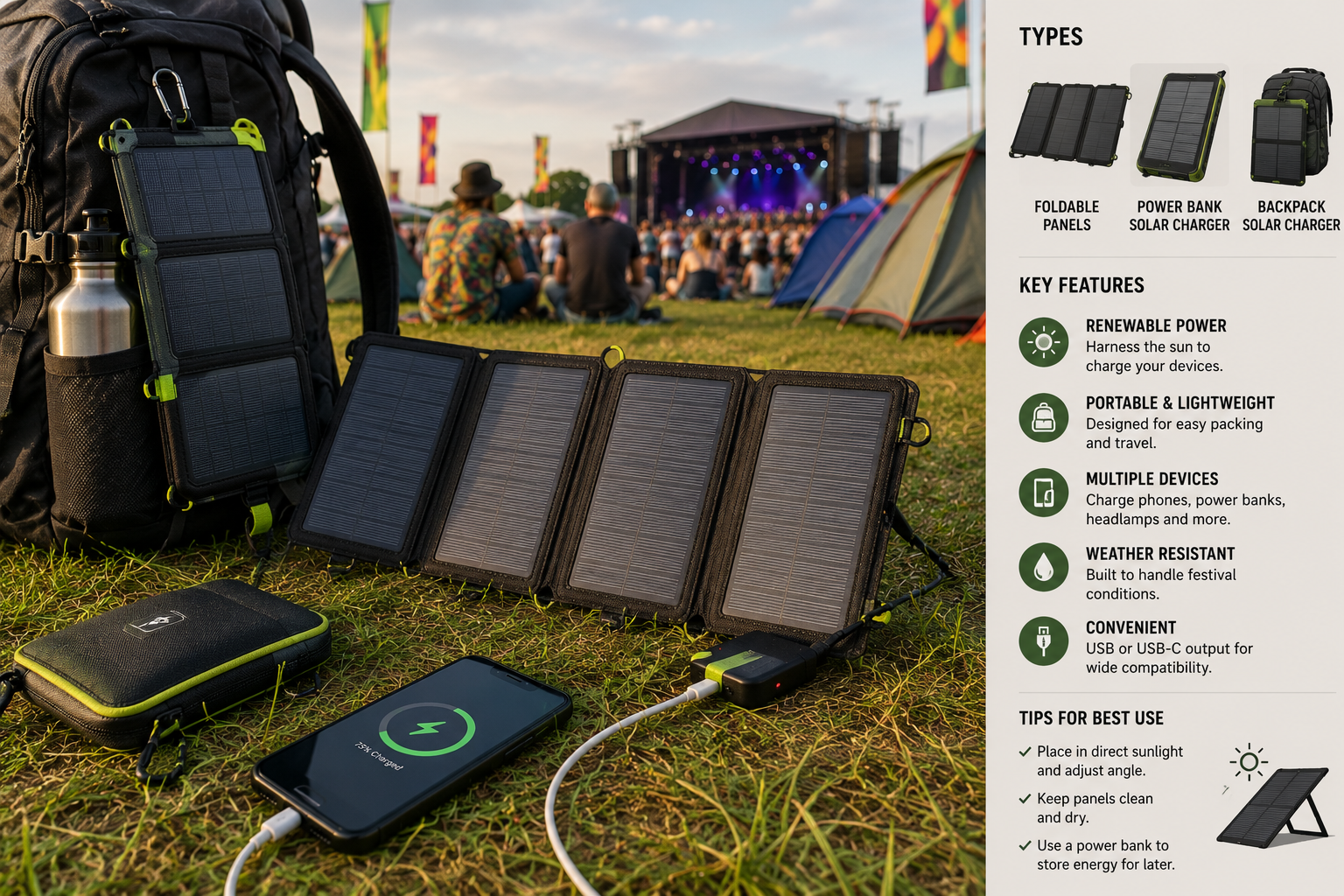
Look for: folding multi-panel design (more surface area, packs small), SunPower or monocrystalline cells (most efficient), USB-C PD output (faster charging), built-in IC chip (handles voltage drops in cloud cover), weatherproofing (doesn’t have to be IP67 — IP54 is fine for festival use).
Solar Power Banks vs Folding Panels
Some power banks have a built-in solar panel on the side. They sound great and they don’t deliver much.
| Format | Solar surface area | Realistic charge time (full) | Use case |
|---|---|---|---|
| Solar power bank (built-in panel) | 30–60 cm² | 20+ days of constant sun | Trickle topping; emergency only |
| Folding 20W panel (separate) | 1500-2000 cm² | 1-2 days of sun for 20,000mAh bank | Genuine festival charging |
Don’t buy a solar power bank as your primary solar solution. The integrated panels are too small. If you want solar, buy a folding panel separately. Pair it with a regular high-capacity power bank that has pass-through charging.
How to Actually Use Solar at a Festival
- Pitch your panel where it gets sun — flat in direct sunlight, not propped at a random angle. Some panels have suspension grommets to hang from a tarp ridge.
- Charge a power bank, not your phone directly. Solar output fluctuates with passing clouds; banks buffer this. Plugging your phone into solar directly often results in stop-start charging that some phones reject.
- Do it during the day while you’re at sets. Set the panel up at the campsite mid-morning, return to a charged bank in the evening.
- Don’t leave panels totally unattended in busy campsites. Theft is rare but happens. If your campsite is sparsely populated, fine. If you’re in central Glastonbury camping, take it inside the tent if you’re away for hours.
- Keep the panel cool if possible. Sun on grass beats sun on dark tarp; ventilation underneath helps.
- Combine with mains pre-charging. Don’t show up at a festival with empty banks expecting solar to fully charge them. Top up from mains before leaving home.
Solar Charging in Bad UK Weather
What happens when the festival weekend gets two days of rain. Realistic outputs:
- Light cloud: 60–80% of rated output. Solar still works.
- Heavy cloud: 30–50% of rated output. Slower but still useful.
- Light rain: 20–40% of output. Most panels are weatherproof; output drops but doesn’t stop.
- Heavy rain: Bring the panel inside the tent. Output near zero anyway.
- Indoor / tent diffuse light: Practically zero useful charge.
On a wet weekend, your power bank capacity is your real backstop. Grab the free Festival Survival Guide PDF for the full prep checklist.
Solar Charger Mistakes to Avoid
- Buying a solar power bank with built-in panel as your main solution. Panel area is too small. Almost decorative.
- Sub-£20 ‘solar charger’ from unbranded sellers. Output is often half the rated wattage; cells degrade fast.
- Trying to charge your phone directly from the panel. Output flicker breaks the charging session. Charge a bank instead.
- Pitching the panel in shade. Sounds obvious. Happens.
- Leaving the panel in direct overhead sun for 8+ hours when you only need a partial charge. Heat damages cells over years. Fold and pack when done.
- Expecting a 10W panel to charge a 26,800mAh bank in a day. Maths says no. Match panel output to bank capacity.
Long-Term Value
Solar pays back over multiple festivals. The maths on a 20W panel at £55:
| Use case | Cost without solar | Cost with solar |
|---|---|---|
| 1 festival, charge from on-site stations | £15–£25 (3-5 charges) | £55 panel, no charges |
| 3 festivals/year, on-site charging | £45–£75/year | £55 once, no recurring |
| 3 festivals/year, 3 years | £135–£225 total | £55 + free thereafter |
| Multi-festival regular over 5 years | £225–£375 total | £55 once, plus camping/holidays use |
Plus: solar gets used outside festivals — camping holidays, allotments, shed/garden office charging, emergency UK power-cut backup. For more on portable power outside festival use, see Best Portable Power for Camping UK.
Frequently Asked Questions
Do solar chargers work in cloudy UK weather?
Yes, but at reduced output. A 20W panel produces 60-80% of rated output in light cloud and 30-50% in heavy cloud. UK summer overcast still produces useful charge. UK winter cloudy weather is too dim for serious festival-style use.
How long does a 20W solar panel take to charge a 20,000mAh power bank?
In direct UK summer sun: 8-12 hours of useful charging time. In cloudy conditions: 16-24 hours. For festival use, you typically charge a bank from 30% to 90% during one day of moderate sun. Full charge from empty in one day is unrealistic.
Are solar chargers waterproof?
Most folding solar panels from BigBlue, Anker and Goal Zero are weather-resistant (IPX4-IPX5) — they handle splashing and light rain but shouldn’t be submerged. Bring them inside the tent during heavy rain. The USB outputs typically have rubber caps to seal.
Can I plug my phone directly into a solar charger?
You can, but it’s not ideal. Solar output fluctuates with passing clouds; many phones interpret these dips as ‘unstable charger’ and stop charging. Charge a power bank from solar, then charge your phone from the bank — much more reliable.
Are solar power banks (with built-in panels) any good?
Generally no. The panel surface area is too small (typically 30-60 cm²) to deliver meaningful charge. They’re marketed as solar but in practice you charge them from mains. The genuine solar options are folding panels separate from the power bank.
Which is the best solar charger for UK festivals?
BigBlue 28W, Anker 21W and Goal Zero Nomad 20 are the most-recommended for UK festival use, all in the £55-£85 range. Choetech 19W is the best budget alternative. Avoid unbranded sub-£25 options — output is unreliable.
Can I run multiple devices from one solar charger?
Yes — most folding panels have 2 or 3 USB outputs. The total wattage divides between devices, so charging two phones from a 20W panel halves the rate to each. Best practice: charge one power bank that then charges devices in series.
Is solar worth it for just one festival a year?
Marginal. A £55 panel pays back over 3-5 festivals if you’d otherwise pay for on-site charging. For one festival a year, two power banks pre-charged from mains are more cost-effective. Solar makes sense for multi-festival regulars or anyone using it outside festivals too.
Can I leave my solar panel charging while I’m at sets?
Yes — that’s the standard approach. Most festival pitches have neighbours who’d notice anything obviously being moved. Theft is uncommon but possible. If your campsite is dense (Glastonbury, Reading), be more cautious; if sparse (Latitude, Green Man), less worry.
What’s the difference between monocrystalline and polycrystalline solar panels?
Monocrystalline panels are more efficient (typically 18-22% efficiency) and produce more output per square cm. Polycrystalline panels are cheaper but bulkier for the same output. For folding festival panels, monocrystalline is the standard. Most modern panels (BigBlue, Anker, Choetech) are monocrystalline.
Related Reading
- Best Festival Power Banks UK
- Best Portable Power for Camping UK
- How to Charge Your Phone at a Festival
- Festival Charging Cable Rules UK 2026
- Festival Camping Tips UK
Solar is one piece of the festival kit picture. Full system in the UK Festival Survival Guide.
Disclosure: This post contains affiliate links. If you buy through them, I may earn a commission at no extra cost to you. I only recommend gear and brands I’d actually use at a UK festival.
Discover more from The Mosh Manual
Subscribe to get the latest posts sent to your email.